
Creatine has evolved from a muscle-building supplement for bodybuilders into a scientifically backed tool for older adults and professionals to fight brain fog, boost memory, and combat daily mental fatigue.
If you walked into a local gym ten years ago, you would likely see massive weightlifters mixing a chalky white powder into their shaker cups. That powder was creatine, and for decades, its reputation was completely locked down. It was the ultimate “bro science” tool designed solely for packing on pounds of raw muscle and hitting heavy bench press personal records.
But if you look at modern health communities like Reddit’s r/Fitness or r/WellnessOver30, something has drastically shifted. The people passionately recommending creatine today aren’t just trying to get huge. Instead, it is 65-year-old grandparents looking to keep their minds sharp, and 30-something office workers trying to survive a brutal 3:00 PM corporate meeting without drowning in coffee.
Why are these two completely different groups suddenly obsessing over the exact same white powder? The answer has absolutely nothing to do with physical bulk, and everything to do with how our bodies power our most demanding organ: the brain.
The Brain Under Siege: Why Mental Work is Physically Exhausting
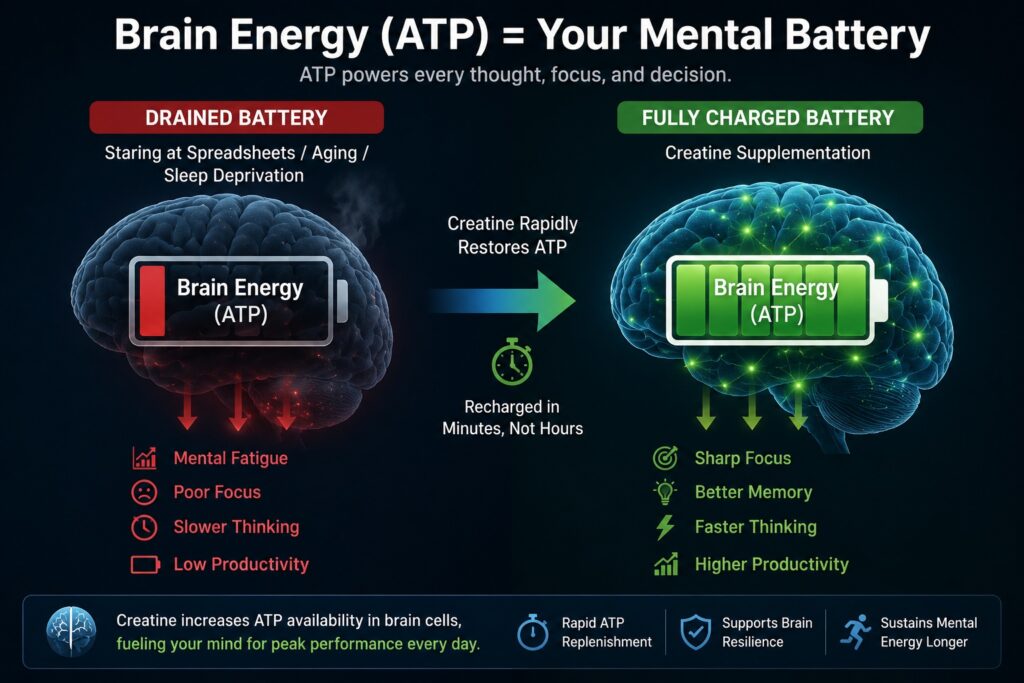
To understand this trend, we have to look at what happens when you stare at a spreadsheet for eight hours or try to recall a specific memory as you age. The human brain is an absolute energy vampire, weighing only about 2% of your total body weight but consuming a massive 20% of your body’s daily energy.
When you are deep in a high-stress project or dealing with age-related cognitive fatigue, your brain cells experience a massive drop in their primary energy currency, a molecule known as ATP (Adenosine Triphosphate). When your brain runs low on ATP, you experience that familiar, heavy sensation of mental burnout and brain fog.
This is exactly where the old-school bodybuilding science takes a brilliant corporate and healthy-aging detour. Creatine’s primary job in skeletal muscle has always been to rapidly donate a molecule to recreate ATP during short, explosive bursts of movement.
Now, landmark clinical research has confirmed that your brain uses the exact same phosphocreatine system to recharge its own batteries during periods of high mental stress.
The Hard Data: What Recent Clinical Studies Say
Some skeptics might think this sounds too good to be true, assuming it is just a marketing trick cooked up by supplement companies. However, the hard data coming out of premier medical institutions tells a remarkably different and highly consistent story.
A comprehensive meta-analysis published in Nutrition Reviews examined multiple randomized controlled trials to see exactly how creatine impacts human memory. The researchers discovered a fascinating twist: while younger, un-stressed adults saw mild changes, older adults aged 66 to 76 experienced a massive, statistically significant boost in forward and backward digit recall tests after taking creatine.
Furthermore, a groundbreaking June 2025 pilot study conducted at the University of Kansas Medical Center (specifically the CABA trial) went even further by tracking brain chemistry directly. Using specialized imaging, scientists found that a higher-dose creatine protocol actually increased brain creatine levels by 11% in participants, leading to measurable, moderate improvements in working memory and day-to-day focus.
| Group | Typical Primary Benefit | Scientific Mechanism |
| Seniors (55+) | Memory recall & mental clarity | Counters age-related decline in natural brain creatine |
| Office Workers | Fatigue resistance & focus | Replenishes ATP during long periods of mental strain |
“But Won’t It Make Me Big, Blown Up, or Bald?”
Whenever regular office workers or older adults hear about this trend, the same anxious questions pop up almost instantly. It is completely natural to ask: “If I start taking this, am I going to wake up looking like a professional bodybuilder, holding tons of water weight, or losing my hair?”
Let’s break down those worries with simple biology. First, creatine cannot magically build massive muscle unless you are actively lifting heavy weights near muscular failure and eating a massive caloric surplus; for a sedentary or lightly active person, it simply provides cellular energy.
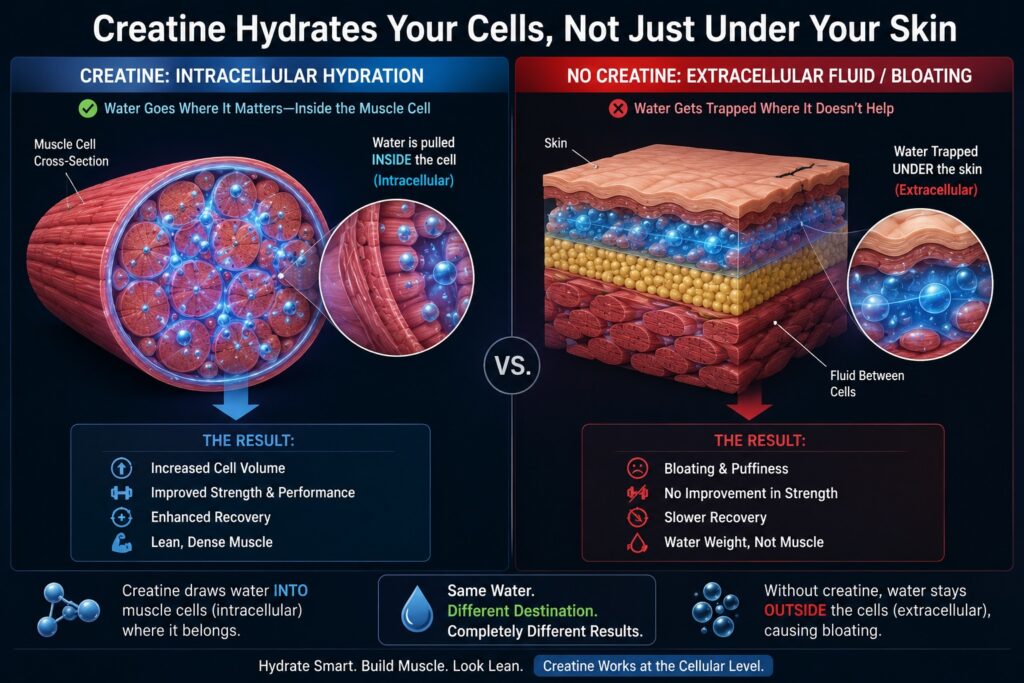
Second, while creatine does cause slight water retention in the first couple of weeks, that fluid is stored entirely inside your cells (intracellular hydration), which makes muscles look healthy and hydrated rather than making your face look bloated.
Finally, the long-standing myth linking creatine to hair loss stems from a single, isolated 2009 study on rugby players that has never been successfully replicated in any modern clinical trial.
The New Daily Routine: How to Actually Take It
Now that the secret is out, how are modern professionals and seniors incorporating this into their lives without overcomplicating things?
The days of complex “loading phases” where you swallow 20 grams of powder a day are largely over for the general wellness crowd.
According to a narrative review published by UCLA Health, the modern approach is incredibly simple: consistency beats intensity. Taking a simple, unflavored dose of 3 to 5 grams of Creatine Monohydrate every single day mixed into your morning coffee, tea, or a glass of water is all it takes to fully saturate your brain and body cells over a period of three to four weeks.
The shift from the locker room to the office breakroom represents a beautiful evolution in how we view nutrition. Creatine is no longer a tool just for building an intimidating physique; it is an affordable, deeply researched, and highly safe mental shield designed to help us navigate the exhausting mental demands of the modern world.
References
- University of Kansas Medical Center (2025): Creatine shows potential to boost cognition in Alzheimer’s patients
- Oxford Academic – Nutrition Reviews: Effects of creatine supplementation on memory in healthy individuals: a systematic review and meta-analysis of randomized controlled trials
- UCLA Health Insights: Why everyone’s talking about creatine beyond athletic performance
Disclaimer: This content is for informational purposes only and is not intended as medical advice, diagnosis, or treatment. Always seek the advice of a qualified healthcare provider with any questions you may have regarding a medical condition.