


A few years ago, most people thought gut health was mainly about digestion.
If you had bloating, constipation, or stomach discomfort, you might have considered taking a probiotic. End of story.
Fast forward to 2026, and the conversation looks very different.
Today, scientists are studying how the trillions of microbes living inside your digestive system may influence your mood, stress levels, mental clarity, sleep quality, and even symptoms of anxiety and depression. The idea sounds almost unbelievable at first.
Can bacteria in your gut really affect what happens inside your brain?
According to a growing body of research, the answer appears to be yes—but the story is more complicated than social media headlines often suggest.
Why Everyone Is Suddenly Talking About the Gut-Brain Axis
One phrase keeps appearing in health news, podcasts, and wellness communities:
The Gut-Brain Axis.
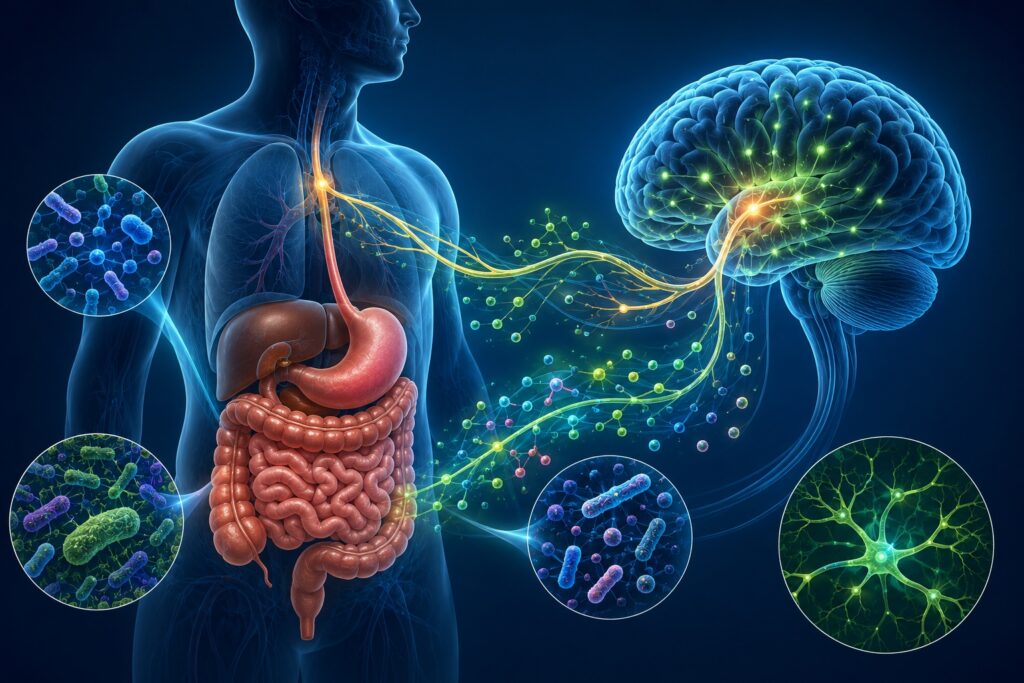
This term describes the constant two-way communication between your digestive system and your brain.
Think of it like a private messaging system.
Your brain sends signals to your gut. Your gut sends signals back.
These messages travel through several pathways, including:
- The vagus nerve
- The immune system
- Hormones
- Neurotransmitters
- Metabolites produced by gut bacteria
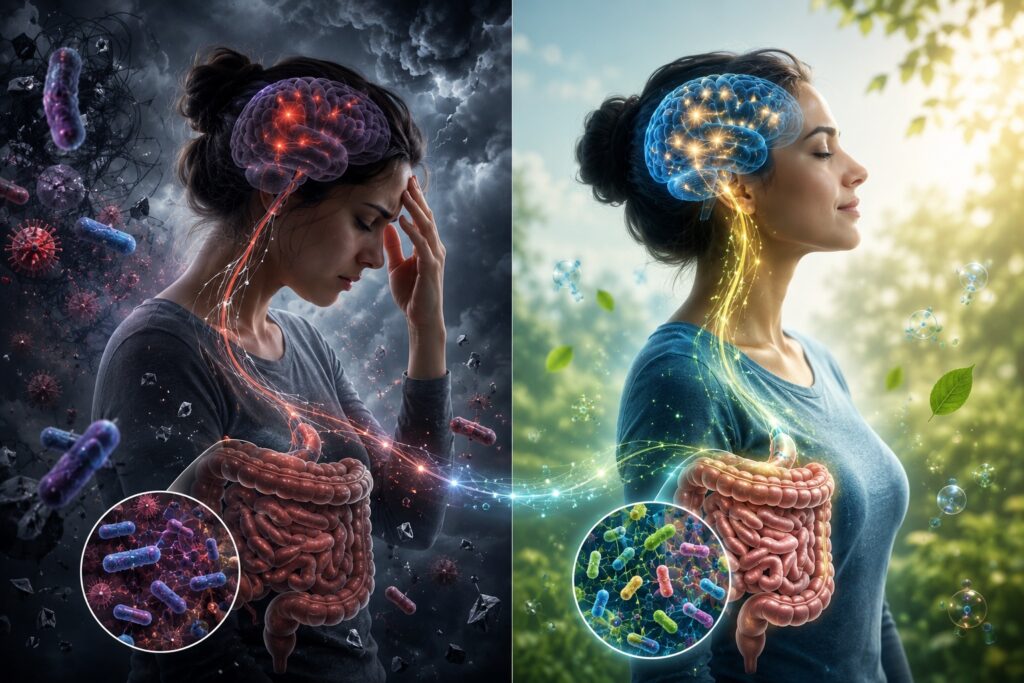
Scientists now believe that disruptions in this communication network may contribute to anxiety, depression, chronic stress, and cognitive difficulties.
What’s especially interesting is that researchers are no longer asking whether the gut and brain are connected.
They’re asking how much that connection matters.
The Mental Health Shift Nobody Saw Coming
Mental health discussions in the United States have changed dramatically over the last few years.
Traditional conversations focused heavily on neurotransmitters like serotonin and dopamine.
Today, many researchers are exploring a bigger question:
What if part of the problem starts in the gut?
Several recent reviews found that people experiencing anxiety and depression often show noticeable differences in their gut microbiome compared with healthy individuals.
That doesn’t automatically mean gut issues cause mental health conditions.
However, it suggests the relationship may be much stronger than previously believed.
This is one reason the concept of psychobiotics has exploded in popularity.
What Are Psychobiotics?
The name sounds futuristic, but the idea is actually pretty simple.
Psychobiotics are probiotics or related compounds that may influence mental health through the gut-brain axis.
Unlike traditional probiotics that focus mainly on digestion, psychobiotics are being studied for their potential effects on:
- Anxiety
- Stress
- Mood
- Sleep
- Focus
- Emotional resilience
Recent scientific reviews published in 2025 and 2026 found growing evidence that certain bacterial strains may help support emotional well-being, although results remain mixed and more large-scale studies are still needed.
That’s an important point.
We’re seeing promising signals—not miracle cures.
Can Gut Health Really Improve Anxiety?
This is where things get interesting.
A large meta-analysis published in 2026 examined randomized controlled trials involving probiotics, prebiotics, and synbiotics for anxiety and depression symptoms. Researchers found evidence suggesting that certain interventions may help reduce symptoms in some individuals.
However, the effects weren’t universal.
Some participants improved noticeably.
Others experienced little or no change.
Researchers believe this may happen because everyone’s microbiome is unique.
In other words, the same probiotic that helps one person may do almost nothing for another.
This idea has become a major discussion point in microbiome communities across Reddit and health forums.
Many users have started focusing less on generic probiotic blends and more on specific bacterial strains that have been studied in human trials.
What About Depression?
Depression research is producing some of the most fascinating findings.
Several reviews published during the past year highlighted potential links between microbiome imbalances, inflammation, and depressive symptoms.
Researchers are especially interested in how gut microbes may influence:
- Inflammatory responses
- Stress hormones
- Serotonin production
- Immune system regulation
Some scientists even refer to depression as partly involving an “inflammatory component” in certain individuals.
Since gut microbes play a major role in regulating inflammation, the connection has attracted enormous attention.
Still, experts caution against oversimplifying the science.
Depression is complex.
Genetics, life experiences, stress, sleep, relationships, and physical health all matter.
Improving gut health should be viewed as one potential piece of the puzzle—not a replacement for professional mental health treatment.
The Surprising Link Between Gut Health and Focus
Most people think about anxiety and depression when discussing the gut-brain axis.
Focus may actually be the next frontier.
Researchers have begun studying how gut bacteria influence:
- Attention
- Cognitive performance
- Mental fatigue
- Stress resilience
Some psychobiotic studies have reported improvements in cognitive function and stress responses, although results remain inconsistent.
This topic has become increasingly popular among biohacking communities and productivity-focused wellness groups.
The reasoning is straightforward:
If your gut influences inflammation, stress hormones, sleep quality, and neurotransmitter production, then it may indirectly affect concentration as well.
Scientists are still working to determine how large that effect really is.
Enter Postbiotics: The Next Evolution of Gut Health
For years, probiotics dominated the conversation.
Now another term is gaining attention:
Postbiotics.
Instead of focusing on live bacteria, postbiotics refer to beneficial compounds produced by bacteria.
Think of them as the useful byproducts created by a healthy microbiome.
Researchers are investigating whether postbiotics might provide some of the benefits associated with probiotics while offering greater stability and consistency.
Many experts believe this could become one of the most important areas of microbiome research over the next decade.
What Are People Saying Online?
One of the most interesting trends isn’t happening inside laboratories.
It’s happening online.
Across Reddit communities focused on microbiome science, supplements, wellness, and biohacking, discussions about psychobiotics have increased significantly over the past year.
Several recurring themes appear again and again:
- People want alternatives to a one-size-fits-all approach.
- Many users are curious about personalized microbiome testing.
- Discussions increasingly focus on specific bacterial strains rather than generic probiotics.
- Interest in anxiety, focus, and mood support continues growing.
Of course, online experiences should never be treated as scientific proof.
But they often reveal where public interest is heading before mainstream healthcare catches up.
So, Should You Start Taking a Psychobiotic?
The honest answer is:
Maybe—but not because of hype.
Current research suggests the gut-brain connection is real.
Researchers are finding evidence that certain probiotics, prebiotics, synbiotics, psychobiotics, and postbiotics may influence mood, anxiety, stress responses, and cognitive function.
However, the science is still developing.
There is no single probiotic strain that works for everyone.
There is no magic supplement that instantly eliminates anxiety.
And there is no evidence that gut-health products should replace medical treatment when dealing with serious mental health conditions.
What researchers consistently agree on is something much less exciting—but far more reliable:
A healthy diet, adequate sleep, regular exercise, stress management, and a diverse microbiome remain the strongest foundations for both physical and mental well-being.
Final Thoughts
The biggest health story of the next decade may not be happening inside the brain alone.
It may be happening inside the gut.
The emerging science of the Gut-Brain Axis is reshaping how researchers think about anxiety, depression, focus, and emotional well-being. While many questions remain unanswered, one thing is becoming increasingly clear:
Your digestive system is doing far more than processing food.
It may be helping shape how you think, feel, and respond to the world around you.
And that possibility is exactly why scientists—and millions of curious people online—are paying attention.
Sources
- Annals of General Psychiatry (2026) – Pre/Pro/Synbiotics and Anxiety & Depression: https://link.springer.com/article/10.1186/s12991-026-00661-6
- Frontiers in Microbiology (2026) – Psychobiotics in Mental Health: https://pubmed.ncbi.nlm.nih.gov/41971341/
- ScienceDirect (2026) – Psychobiotics Systematic Review: https://www.sciencedirect.com/science/article/pii/S0278584626000321
- BMC Psychiatry (2025) – Probiotics, Anxiety, Depression & Sleep: https://link.springer.com/article/10.1186/s12888-025-07644-z
- Frontiers in Neuroscience (2025) – Personalized Psychobiotics: https://www.frontiersin.org/journals/neuroscience/articles/10.3389/fnins.2025.1711846/full
- Health.com – Mood and Probiotics Research Summary: https://www.health.com/can-probiotics-boost-mood-11718737
- Community Discussion Sources:
- Reddit r/Microbiome
- Reddit r/microbiomenews
- Reddit r/Supplements
Disclaimer: This content is for informational purposes only and is not intended as medical advice, diagnosis, or treatment. Always seek the advice of a qualified healthcare provider with any questions you may have regarding a medical condition.