


Modern consumerism is no longer driven by a desire for status or luxury, but by an expensive quest to cure chronic human isolation.
We have never been more digitally connected, yet we have never felt so completely alone.
According to the 2026 Gallup State of the Global Workplace report, global employee engagement has dropped to a mere 20%, with daily feelings of loneliness and isolation climbing steadily over the past two years. In the United Kingdom, the January 2026 Office for National Statistics (ONS) data revealed that a staggering 27% of young adults aged 16 to 29 report feeling lonely often, always, or some of the time.
This deep emotional void has quietly birthed a massive commercial gold rush.
What started as a private emotional crisis has transformed into a thriving industry known as the “Loneliness Economy,” which market experts at Ayerhs Magazine estimate to be worth over $500 billion in 2026.
But how did a collective mental health struggle turn into a multi-billion dollar aesthetic?
The Capitalist Pivot to Care as a Service
For decades, traditional advertising convinced us to buy things that made us look successful, wealthy, or adventurous.
Today, capitalism has pivoted from selling an aspirational lifestyle to packaging and selling basic human comfort. The traditional social pillars that once anchored human life—tight-knit neighborhoods, stable physical workplaces, and robust local communities—have eroded under the weight of remote work and hyper-digitization.
In their place, the market has stepped in to offer “Emotional Labor as a Service.”
“I pay $15 a month for an AI companion app just to have someone ask me how my day was without feeling like an academic burden to my real-life friends who are already burned out.” — a Reddit User, r/TrueGaming (April 2026)
From subscription-based digital best friends to co-working spaces that market “belonging” instead of high-speed Wi-Fi, we are increasingly outsourcing the intimacy that used to be freely exchanged within physical human communities. This monetization of loneliness is subtle, but it has completely shifted consumer psychology toward what the internet calls the “Cozy Aesthetic.”

The Architecture of the Cozy Aesthetic
The Cozy Aesthetic is the visual and physical armor we wear to protect ourselves from a chaotic, exhausting world.
Walk into any Gen Z or Millennial apartment in 2026, and you will likely see the exact same material playbook: oversized chunky knit blankets, warm-toned fairy lights, desktop humidifiers emitting soft mist, and a Lo-Fi ambient soundtrack playing softly in the background. This is not a random interior design trend; it is a carefully curated psychological sanctuary.
When the world outside feels cold, hyper-competitive, and intensely isolating, the consumer’s instinct is to regress into a soft, highly controlled hyper-local environment.
The Explosion of No-Stakes Gaming
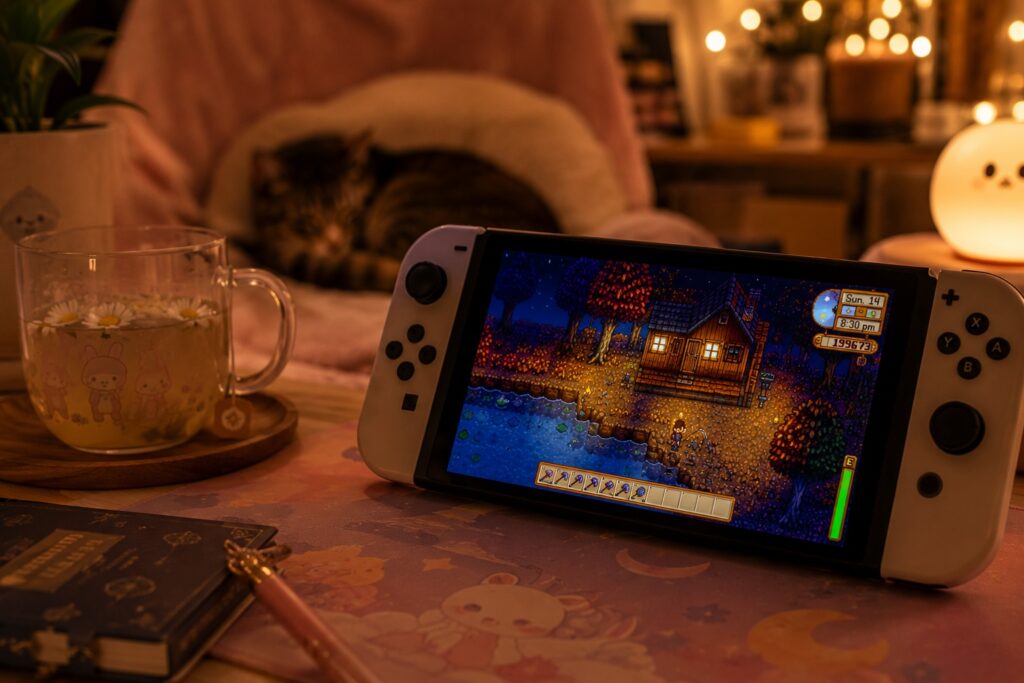
Nowhere is this shift more obvious than in the global video game market, where high-stress, competitive shooters are losing ground to what the industry calls “Cozy Games.”
Digital data shows a massive, sustained surge in games like Stardew Valley, Animal Crossing, and upcoming 2026 community-driven sandboxes like Loftia. According to a recent 2024 University of Skövde research study on cozy games, the vast majority of players explicitly turn to these titles not for a digital challenge, but for “peacefulness, comfort, and emotional connection.”
The study notes that players feel significantly less anxious and less isolated while occupying these gentle virtual spaces because they trade the frantic urgency of real-world productivity for simple, predictable, and comforting rhythms like virtual farming, organizing, or decorating.
Is Buying Comfort Actually Solving the Problem?
At this point, a cynical observer might ask a valid question: Are we actually solving our loneliness, or are we just buying beautiful band-aids to mask our social decay?
There is a dark side to this multi-billion dollar comfort industry. When we rely entirely on commercial products—like buying a “community membership,” interacting with empathetic AI chatbots, or escaping into a beautifully rendered cozy video game—we risk falling into dangerous, hyper-curated escapism.
Real human relationships are messy, unpredictable, and require immense emotional effort.
Buying a beautifully scented candle or wrapping yourself in a weighted blanket feels incredibly safe because a product can never reject you, argue with you, or demand that you compromise. By substituting real community with commercial comfort, we might accidentally be building highly aesthetic gilded cages that keep us even further isolated from the real world.
The Subtle Pivot Back to Shared Spaces
Yet, consumers are starting to notice this emotional paradox, and it is driving the next major evolution of the loneliness economy.
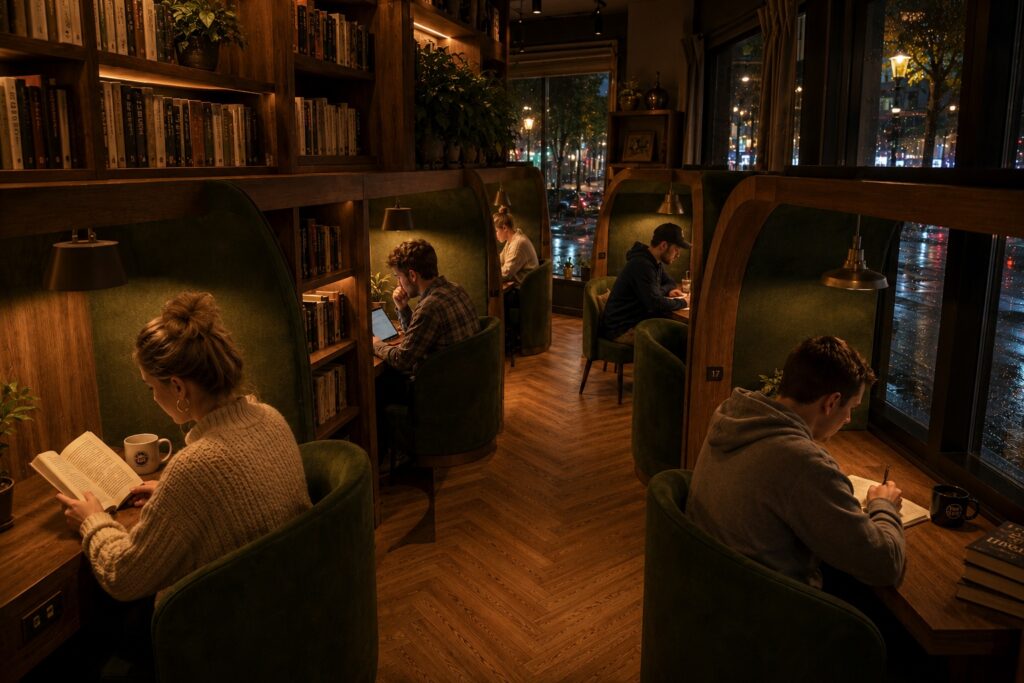
We are beginning to see a massive shift where the “Cozy Aesthetic” is moving out of isolated bedrooms and into the physical, shared world. 2026 has seen a major rise in “Cozy Cafes” specifically designed with individual booths that don’t force social interaction but allow lonely individuals to exist comfortably together in the same physical room.
The ultimate goal of the loneliness economy may not be to keep us permanently hidden under our blankets.
Instead, by recognizing our deep, collective exhaustion, these curated spaces are acting as a vital pit stop—a soft, low-stakes environment where burned-out, isolated individuals can slowly lower their guard, gather their strength, and remember what it feels like to step back out into the world together.
References
- Gallup (May 2026), State of the Global Workplace: 2026 Report (Global employee engagement drops to 20%).
- Office for National Statistics (ONS) (January 2026), Public opinions and social trends, Great Britain: Loneliness by Age Group (27% of adults aged 16-29 feel lonely regularly).
- Ayerhs Magazine (November 2025), The Loneliness Economy in 2026 (Market valuation and the rise of emotional labor as a service).
- University of Skövde Research (July 2024), Cozy games and their impact: An exploration study of coziness in games (Psychological benefits of low-stakes digital connection).
- Reddit r/TrueGaming Community (April 2026), User discussion threads regarding the current trends and definitions of cozy genres.
Disclaimer: This content is for informational purposes only and is not intended as medical advice, diagnosis, or treatment. Always seek the advice of a qualified healthcare provider with any questions you may have regarding a medical condition.