Have you ever looked at a price tag and had your jaw literally drop? Well, America just looked at its national healthcare bill, and let’s just say, it’s a number that requires a lot of zeros.
According to the latest official data from the Centers for Medicare & Medicaid Services (CMS), US healthcare spending has officially ballooned to a mind-boggling $5.7 trillion. To put that in perspective, that is larger than the entire economy of countries like Germany or Japan!
But here is the twist: doctors and hospitals aren’t suddenly charging ten times more for a basic check-up. The prices themselves didn’t jump as much as you’d think. Instead, the real culprit is utilization. In simple terms? Americans are using a lot more medical services, tests, and—most importantly—prescription drugs.
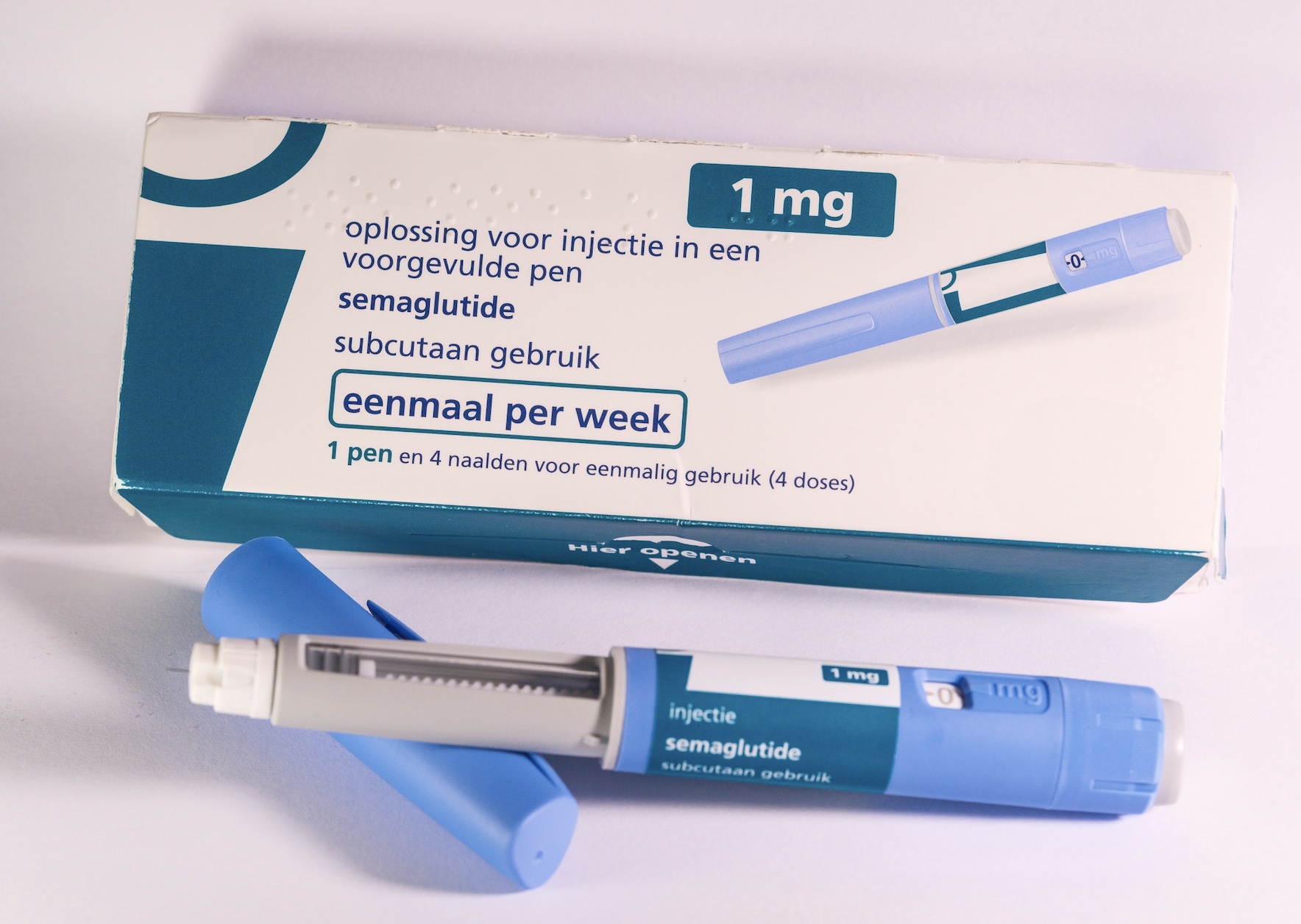
And at the absolute center of this multi-trillion-dollar storm is a class of medications you’ve probably seen all over TikTok, Instagram, and the evening news: GLP-1 drugs like Wegovy and Zepbound.
Let’s dive into how these highly popular weight-loss shots are completely rewriting the rules of American medicine, and why a massive “insurance war” is breaking out in living rooms and corporate offices across the country.
What on Earth is a GLP-1 Drug, Anyway?
Before we talk about the trillions of dollars, let’s break down the science into plain English.
GLP-1 stands for Glucagon-Like Peptide-1. Sounds like a spaceship part, right? But it’s actually a hormone that your body naturally makes in your gut. When you eat, this hormone tells your brain, “Hey, we’re full! Stop eating!” It also slows down how fast your stomach empties, so you feel satisfied for a longer time.
For years, scientists used drugs that mimic this hormone to help people with Type 2 Diabetes manage their blood sugar. Brands like Ozempic and Mounjaro became household names for this exact reason.
But then, researchers noticed a massive “side effect”: patients taking these drugs were losing a significant amount of weight.
This led pharmaceutical companies to create versions specifically approved for chronic weight management. Enter Wegovy (made by Novo Nordisk) and Zepbound (made by Eli Lilly). For millions of Americans struggling with clinical obesity, these drugs have been nothing short of a miracle, helping people lose 15% to 20% of their body weight.
The $5.7 Trillion Problem: It’s All About the Volume
So, if these drugs are helping people get healthier, why is the US government sweating over a $5.7 trillion bill?
It comes down to a basic math problem: Incredible Demand + High Prices = Financial Melt-down.
In many countries with centralized healthcare systems, governments negotiate drug prices down to a fraction of what they cost in the US. But in the American system, a single month’s supply of Wegovy or Zepbound can retail for anywhere between $1,000 and $1,350 if you don’t have good insurance.
Now, multiply that $1,000+ per month by the millions of Americans who qualify for and want these medications.
According to the CMS actuarial reports, it’s not just that the list prices of drugs went up; it’s that the volume of prescriptions filled skyrocketed at a rate never seen before in modern medical history. The sheer utilization of GLP-1 drugs has created a massive tidal wave that is putting immense pressure on both private employer insurance plans and government programs like Medicare and Medicaid.
Inside the “Coverage War”: The Fight for the Golden Ticket
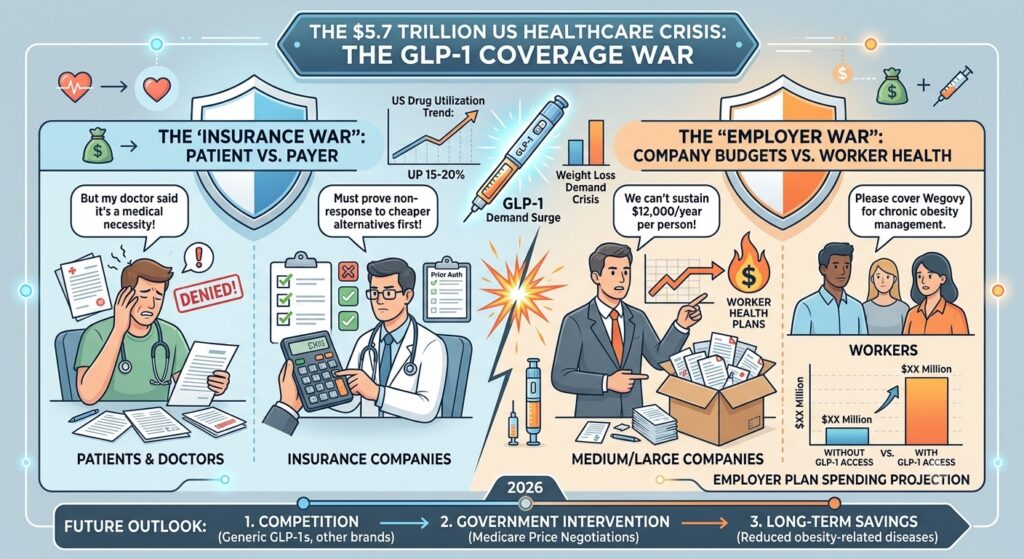
Because these medications are so expensive, a massive battle—the GLP-1 Coverage War—is currently playing out across America.
On one side, you have patients and doctors. On the other side, you have insurance companies (payers) and employers who fund health benefits.
The Patient’s Nightmare: The Dreaded “Prior Authorization”
If you browse through health forums on Reddit or Facebook groups, you will see a community filled with a mix of incredible success stories and deep, burning frustration.
Many users report that even if their doctor writes a prescription for Wegovy or Zepbound, their insurance company will flat-out deny it. To get approval, patients have to go through a complicated process called Prior Authorization. This is essentially a giant checklist where the insurance company says: “Prove to us that you tried regular dieting, exercised for six months, took cheaper generic pills, and are still clinically at risk before we pay for this expensive shot.”
One viral post on a popular weight-loss subreddit summarized the mood perfectly:
“My doctor says this drug could literally save me from a future heart attack, but my insurance company denied it because my Body Mass Index (BMI) was 0.5 points below their arbitrary cutoff. I feel like I’m being punished for trying to get healthy before it’s too late.”
The Employer’s Nightmare: Going Bankrupt Trying to Keep Workers Healthy
But if we flip the coin, insurance companies and employers aren’t just being mean for the sake of it. They are genuinely panicking about running out of money.
Most medium-to-large companies in the US are “self-insured,” meaning the company itself pays the medical bills of its employees out of its own pocket. If a company has 1,000 employees, and 100 of them get prescribed a GLP-1 drug at $12,000 a year, that’s an extra $1.2 million the company has to find out of nowhere.
To cope with this, many major corporations and state health plans have made the difficult decision to either completely drop coverage for weight-loss drugs or introduce incredibly strict rules to limit who can get them.
What the Experts (and the Internet) Are Saying
This crisis has sparked an intense debate among economists, medical professionals, and everyday citizens.
- The Optimistic View (The Long-Term Investment): Many doctors argue that spending money on GLP-1 drugs now will actually save the US healthcare system trillions of dollars in the long run. Obesity is a root cause of many chronic diseases, including Type 2 diabetes, heart disease, stroke, and certain types of cancer. By treating obesity early, we might avoid expensive surgeries, hospital stays, and long-term disability down the road.
- The Pessimistic View (The Immediate Budget Crisis): Health economists warn that our system operates on yearly budgets, not fifty-year timelines. If Medicare (the government insurance for seniors) is forced by law to cover these drugs for everyone who wants them, it could exhaust the program’s trust funds much faster than expected, leading to higher taxes or premium increases for every single American.
On community platforms like X (formerly Twitter), the conversation is highly polarized. Some users argue that pharma companies are practicing “price gouging” by charging Americans five to ten times more than European patients for the exact same injection pen. Others point out the harsh reality of the American healthcare design, where health is often treated as a luxury item rather than a basic human right.
Looking Ahead: Will the Storm Calm Down?
Is there any hope for peace in this coverage war? Yes, but it will take time. There are a few things that could change the game over the next few years:
- More Competition: Right now, Novo Nordisk and Eli Lilly have a virtual duopoly (where only two companies control the market). However, dozens of other pharmaceutical companies are currently rushing to develop their own GLP-1 alternatives, including oral pills that don’t require shots. More competition usually means lower prices.
- Generic Versions: Eventually, patents expire, and cheaper generic versions will hit the shelves. But because these biological drugs are complex to manufacture, true low-cost generics are still years away.
- Government Intervention: There is growing political pressure on Capitol Hill for Congress to allow Medicare to directly negotiate lower prices for weight-loss medications, just as they recently started doing for other high-cost drugs.
Wrap-Up: The Trillion-Dollar Question
The $5.7 trillion healthcare milestone is a massive wake-up call. It proves that America has a nearly infinite appetite for life-changing medical innovations, but a deeply fragile system for actually paying for them.
The GLP-1 revolution has proven that obesity is a complex medical condition, not a personal willpower failure. But until the country finds a way to balance the massive volume of demand with sustainable economic pricing, the “Coverage War” will continue to rage on—leaving millions of ordinary citizens caught right in the middle.
What do you think? Should insurance companies be forced to cover these life-changing drugs for everyone, or do we need to limit access to keep health insurance affordable for all? Let us know your thoughts in the comments below!
References
- Centers for Medicare & Medicaid Services (CMS): National Health Expenditure Data & Historical Reports (Official US government agency providing the baseline $5.7 trillion spending statistics and utilization insights).
- KFF (Kaiser Family Foundation): Health Costs and GLP-1 Coverage Analysis (In-depth independent research detailing how employer-sponsored insurance plans are reacting to weight-loss drug demands).
- Reddit Communities: Insights and public sentiment gathered from the
r/WegovyWeightLossandr/Zepboundsubreddits regarding prior authorization hurdles and insurance denial experiences.
Disclaimer: This content is for informational purposes only and is not intended as medical advice, diagnosis, or treatment. Always seek the advice of a qualified healthcare provider with any questions you may have regarding a medical condition.