
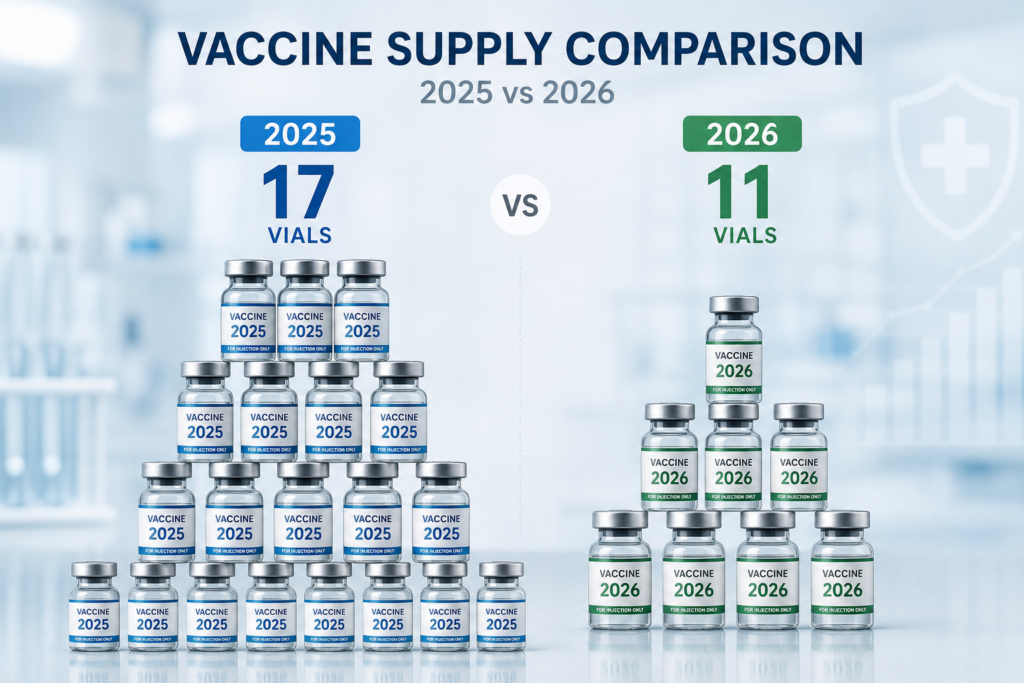
The U.S. government has officially reduced the recommended childhood vaccine list from 17 to 11, sparking a massive global debate on medical standards and national health sovereignty.
From 17 to 11: The New US Immunization Standard vs. Global Peer Nations
Have you ever wondered why American children used to receive significantly more vaccines than their peers in Europe or Japan? For decades, the U.S. CDC schedule was the gold standard, but a radical shift in early 2026 has turned that logic upside down.
This change wasn’t just a minor tweak; it was a systematic removal of six major vaccines from the “routine” list to a “clinical decision” status. The world is watching as the United States moves from being the most vaccinated nation to one with a leaner, more selective approach.
You might think, “Less protection must mean more risk,” right? However, the Department of Health and Human Services (HHS), led by Robert F. Kennedy Jr., argues that this brings the U.S. in line with “global peer nations” like Denmark and Germany.
According to the new guidelines released on January 5, 2026, vaccines for Rotavirus, Influenza, Hepatitis A, Hepatitis B, Meningococcal, and RSV are no longer mandatory for school entry. Instead, these are now classified under “Shared Clinical Decision-Making” (SCDM), meaning parents and doctors must decide together.
But here is where the story takes a sharp turn: How do these 11 remaining vaccines actually compare to the rest of the developed world? If you look at Japan or Sweden, you’ll find that their schedules have been leaner for years without a collapse in public health.
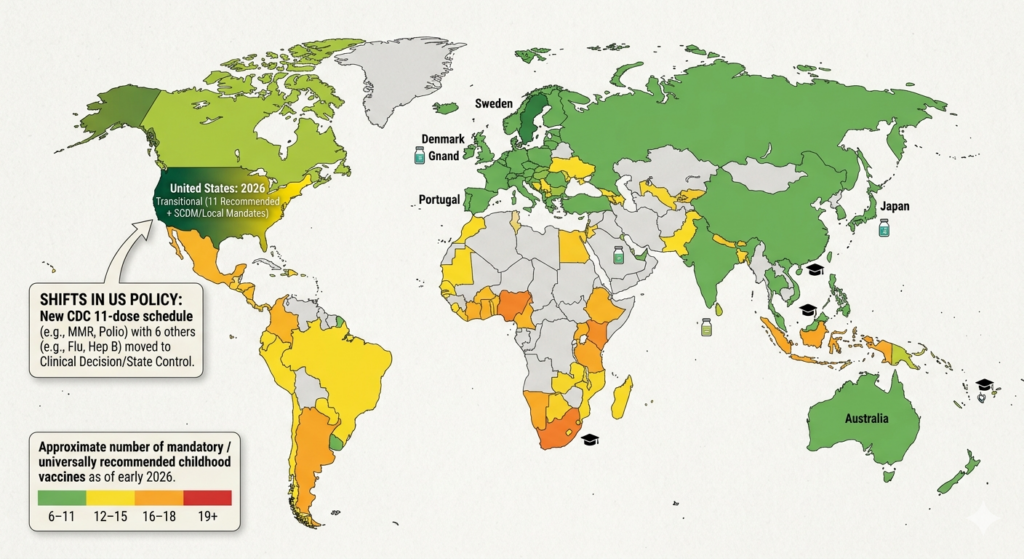
Critics, however, are sounding the alarm, claiming this “alignment” is a dangerous gamble with herd immunity. Medical associations like the American Academy of Pediatrics (AAP) argue that the U.S. has a unique demographic density that requires the original 17-vaccine shield.
“If European kids are fine with fewer vaccines, why can’t American kids be?”
The answer lies in the infrastructure of public health tracking, which is far more robust in countries like Norway than in the diverse, mobile population of the U.S.
On Reddit’s r/Science and r/Parenting, the comments are a battlefield. One top-voted comment reads,
“I moved from Germany and was shocked at the 17-dose list; this feels like a return to sanity.”
Another counters, “We are literally inviting polio and measles back to the table for political points.”
The tension reached a boiling point on March 16, 2026, when a Federal Court issued a “Stay” order, temporarily blocking these changes. This means that while the policy says “11,” the legal reality for schools is currently stuck in a “17-dose” limbo until the final verdict.
So, is the U.S. leading a new era of medical freedom, or is it falling behind the global standard of safety? The data from the next 12 months of infection rates will provide the answer that no politician or doctor can ignore.
Sources
- Kaiser Family Foundation (KFF): “Analysis of US Childhood Immunization Changes” (Updated Jan 2026).
- AP News: “Federal Court Blocks HHS Vaccine Schedule Overhaul” (March 16, 2026).
- CDC Official Release: “2026 Recommended Immunization Schedule for Children and Adolescents.”
- European Centre for Disease Prevention and Control (ECDC): “Vaccine Scheduler – Comparison of EU/EEA Nations.”
Disclaimer: This content is for informational purposes only and is not intended as medical advice, diagnosis, or treatment. Always seek the advice of a qualified healthcare provider with any questions you may have regarding a medical condition.