


The unpredictable shift in global weather patterns is no longer just an environmental crisis; it has evolved into a direct, measurable threat to your everyday neurological and physical well-being.
Traditional wellness routines focus heavily on clean eating, daily cardio, and standard mindfulness applications to reduce corporate stress.
However, as extreme weather events break historical boundaries, a new paradigm called preventive climate medicine is gaining immense traction across North America.
Modern adults are realizing that traditional self-care fails to address a deeper, more systemic issue: the physiological and psychological toll of a rapidly changing planet.
But what exactly happens to your nervous system when the environment around you feels permanently unstable?
The Invisible Weight: Understanding the Surge of Eco-Anxiety
Eco-anxiety is officially defined by the American Psychological Association (APA) as a chronic fear of environmental doom.
This is not a vague, philosophical worry about the year 2050; it is an active, daily psychological stressor affecting millions of Americans right now.
Recent systematic data released in early 2026 by the MDPI Sustainability journal indicates that approximately two-thirds (66%) of surveyed adults in the United States report feeling notable levels of climate anxiety or concern about environmental shifts.

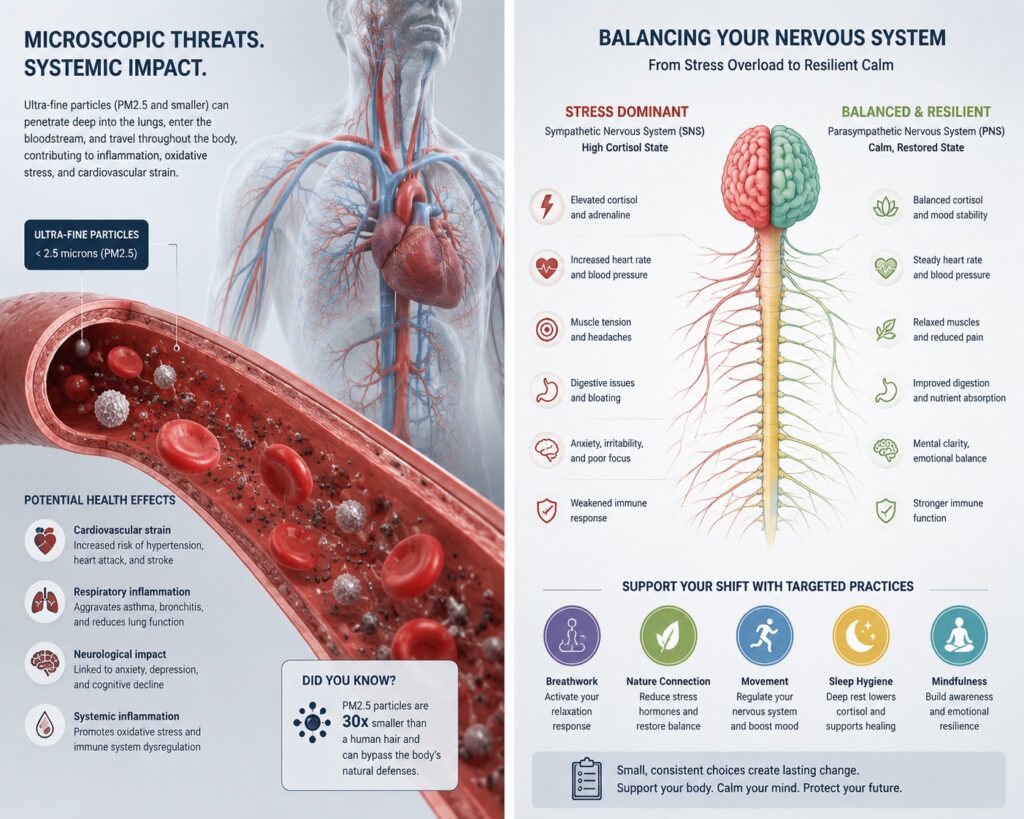
This psychological weight triggers a continuous cascade of cortisol and adrenaline, keeping the human sympathetic nervous system stuck in a permanent “fight-or-flight” state. Medical professionals note that chronic exposure to environmental disasters—even indirectly through repetitive digital media consumption—manifests as severe sleep disruption, existential dread, and unexplained fatigue.
On major online platforms like Reddit, community threads are flooded with users noting that they experience a unique sense of “ecoparalysis“—a state of being so overwhelmed by global weather shifts that they struggle to complete basic daily tasks.
The critical question we must ask is whether this anxiety is purely psychological, or if it is actively altering our internal physical biology.
The Physical Toll: Extreme Weather and Internal Toxicity
The physical degradation caused by climate shifts extends far beyond the immediate dangers of heatstroke or wildfire smoke. According to the groundbreaking 2025 Lancet Countdown report, extreme environmental factors are now directly linked to deteriorating baseline cognitive functions and rising mortality rates globally. For instance, prolonged exposure to extreme heat and high humidity has been shown to impair direct brain functions, accelerate cellular aging, and significantly increase systemic stress levels.
Furthermore, the environmental crisis has accelerated our daily exposure to microscopic synthetic pollutants. A collaborative medical study published in April 2026 by ECOTON and the Wonjin Institute of South Korea revealed a startling statistic: 100% of tested human blood samples contained detectable levels of microplastics. These ultra-fine filaments slip past the body’s natural defenses in the gut lining and lungs, entering the circulatory system and triggering persistent, symptomless chronic inflammation.
Many skeptics argue that human bodies have always adapted to environmental shifts over centuries, so why should we suddenly panic now?
While true adaptation occurs over thousands of years, the current velocity of synthetic pollution and climate instability is vastly outpacing our natural evolutionary defenses.
The human body does not recognize microplastics or persistent synthetic airborne particles as organic elements; it treats them as foreign invaders, exhausting the immune system over time. Therefore, relying purely on old-school wellness strategies is no longer sufficient to keep your biology protected.
Ready Is the New Well: Designing a Climate-Proof Action Plan
To survive this modern era of environmental instability, your wellness routine must transition into an active, resilient defense system. The concept of “Ready Is the New Well” focuses entirely on building internal physical stamina and mental boundaries to withstand external ecological pressures. Experts suggest implementing strict digital boundaries to prevent media oversaturation, alongside targeted somatic breathing exercises to reset your overstimulated vagus nerve.
Additionally, reducing your systemic toxic load is essential to support your body’s natural filtration pathways. While a complete microplastic detox is impossible since these particles are now ubiquitous in our water and air, you can drastically minimize further accumulation.
Medical reviews published in early 2026 recommend using high-efficiency particulate air (HEPA) filtration systems indoors, utilizing certified multi-stage water filters, and completely avoiding the heating of food in synthetic plastic containers.
By combining strict mental hygiene with proactive physical detoxification, you shift your biology from a state of constant vulnerability to one of sustainable environmental resilience.
References
- The Lancet Countdown (2025 Report on Health and Climate Change): https://lancetcountdown.org/2025-report/
- MDPI Sustainability Journal (2026 Literature Review on Climate Anxiety): https://www.mdpi.com/2071-1050/18/4/2049
- ECOTON & Wonjin Institute Blood Study (April 2026 Findings): https://ecoton.or.id/the-body-is-the-new-battlefield-ecotons-blood-tests-find-microplastics-in-100-of-human-samples-tested/
- Mental Health Commission of Canada (Understanding and Coping with Eco-Anxiety): https://mentalhealthcommission.ca/resource/understanding-and-coping-with-eco-anxiety/
Disclaimer: This content is for informational purposes only and is not intended as medical advice, diagnosis, or treatment. Always seek the advice of a qualified healthcare provider with any questions you may have regarding a medical condition.