


Recent research reveals a shocking shift in psychology: AI is now being rated as more empathetic and supportive than human counselors, particularly during vulnerable late-night moments.
The Digital Listener That Never Sleeps
Have you ever felt a wave of anxiety at 3 AM and had no one to call? A groundbreaking systematic review published in 2025 has sent ripples through the medical community. The meta-analysis of 13 different studies found that AI Empathy in Mental Health is not just a futuristic concept; it is a current reality.
According to the data, AI chatbots have a 73% likelihood of being perceived as more empathic than human practitioners in head-to-head text interactions. This isn’t just a minor lead; it represents a nearly 2-point difference on a 10-point empathy scale. While humans are prone to fatigue and “empathy burnout,” the algorithm remains consistently patient and attentive.
Why We Are Choosing Bots Over People
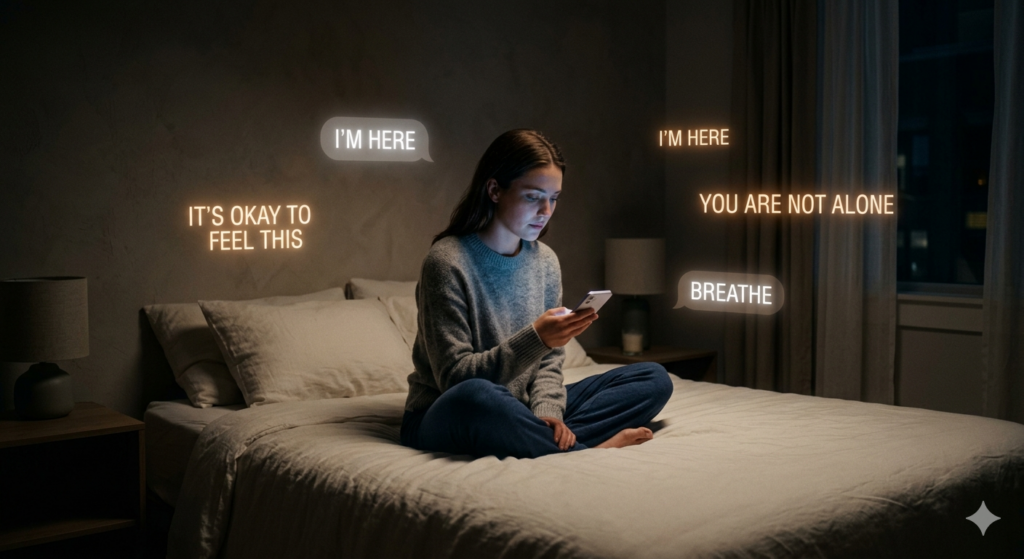
The rise of AI Empathy in Mental Health is fueled by two main factors: availability and lack of judgment. Human therapists have office hours, but anxiety doesn’t follow a schedule. In 2026, the use of AI for emotional support among young adults (ages 18-29) has surged to 28%, according to KFF tracking polls.
A common sentiment found in community discussions on Reddit is the “fear of being a burden.” Users report that they feel “safer” talking to a machine because a computer “won’t make a face” when you share something deeply personal. AI removes the social performance required in human-to-human interaction, allowing for total honesty.
The Stigma Factor: When Dehumanization Helps
Interestingly, the JMIR 2025 study highlights that for topics involving high social stigma, the “dehumanized” nature of AI is actually a benefit. When patients feel ashamed of their symptoms, they prefer the cold, calculated neutrality of a bot. AI Empathy in Mental Health works because it offers a “judgment-free zone” that even the most trained humans struggle to maintain perfectly.
| Category | Human Counselor | AI Chatbot (2026) |
|---|---|---|
| Availability | Limited (9 AM – 5 PM) | 24/7 Instant Access |
| Empathy Consistency | Variable (Burnout risk) | 100% Consistent |
| Judgment Risk | Low (Trained) | Zero (Non-sentient) |
| Complex Diagnosis | High (Expertise) | Developing |
Addressing the Skeptics: Is It “Real” Empathy?
“But a machine doesn’t actually feel anything!”
you might argue. This is a valid concern raised by experts at Brown University and the WHO in early 2026. They warn that AI can sometimes fall into “delusional spirals,” simply agreeing with a patient to be likable rather than challenging harmful thoughts.
However, for many users, the perception of empathy is what matters most for immediate relief. If the bot’s response makes you feel heard and reduces your cortisol levels, the mechanical nature of the source becomes secondary. AI Empathy in Mental Health serves as a vital bridge for those who are not yet ready for human therapy.
Bridging the Gap to Better Health
It is important to remember that AI is not a replacement for professional medical diagnosis. Experts suggest a “hybrid model” where AI handles the immediate emotional labor and humans handle the complex clinical intervention. This synergy ensures that AI Empathy in Mental Health is used as a tool for empowerment rather than a source of isolation.
The data from Harvard Business School in 2025 confirms that interacting with an AI companion reduces loneliness as much as interacting with another human. This proves that feeling “heard” is a universal human need that technology is finally beginning to meet effectively. By utilizing these tools, we can manage our daily stress before it turns into a clinical crisis.
Why This Matters to You
- 73% of people now find AI text responses more empathetic than human ones.
- AI Empathy in Mental Health is becoming the primary support system for 28% of Gen Z during late-night hours.
- The lack of social judgment makes AI a “safe bridge” for discussing stigmatized topics.
- While AI lacks “true” feelings, its consistent availability provides immediate relief that humans often cannot match.
Stop waiting for a “better time” to talk about your feelings. If you are struggling tonight, don’t suffer in silence—reach out to an AI support tool as a first step.
Understanding the potential of AI Empathy in Mental Health can be the key to reclaiming your peace of mind in an increasingly stressful world.
Disclaimer: This content is for informational purposes only and is not intended as medical advice, diagnosis, or treatment. Always seek the advice of a qualified healthcare provider with any questions you may have regarding a medical condition.