


Imagine walking into a restaurant, ordering dinner, eating the entire meal, and then being told:
“We’ll let you know how much it costs in a few weeks.”
Sounds ridiculous, right?
Now imagine getting a second bill because the person who brought your food worked for a different company. Then a third bill because the kitchen used a special piece of equipment. And maybe another charge that nobody clearly explained before you sat down.
Welcome to the confusing world of American medical billing.
Hospital price transparency has been a major healthcare issue in the United States for years. Federal rules now require hospitals to publish detailed pricing information, and the government has continued strengthening those requirements.
But here’s the problem.
Publishing prices does not automatically mean patients can easily understand what they will actually pay.
That difference is at the heart of the medical billing transparency debate in 2026.
According to the Centers for Medicare & Medicaid Services, or CMS, updated Hospital Price Transparency requirements began being enforced on April 1, 2026. The new rules are designed to make hospital pricing data more accurate, standardized, and useful.
The goal sounds simple: patients should be able to understand healthcare prices before receiving treatment.
The reality is much more complicated.
So why are US healthcare costs in 2026 still so difficult to understand? Why do patients continue complaining about hidden hospital fees? And what rights do Americans have when facing confusing medical bills?
Let’s break it down.
Hospital Price Transparency: What Does It Actually Mean?
First, we need to understand what hospital price transparency is supposed to do.
Under federal Hospital Price Transparency rules, hospitals must publicly provide pricing information.
This includes machine-readable files containing standard charges and consumer-friendly information for certain healthcare services.
In simple English, hospitals are supposed to tell people what medical care costs.
That sounds straightforward.
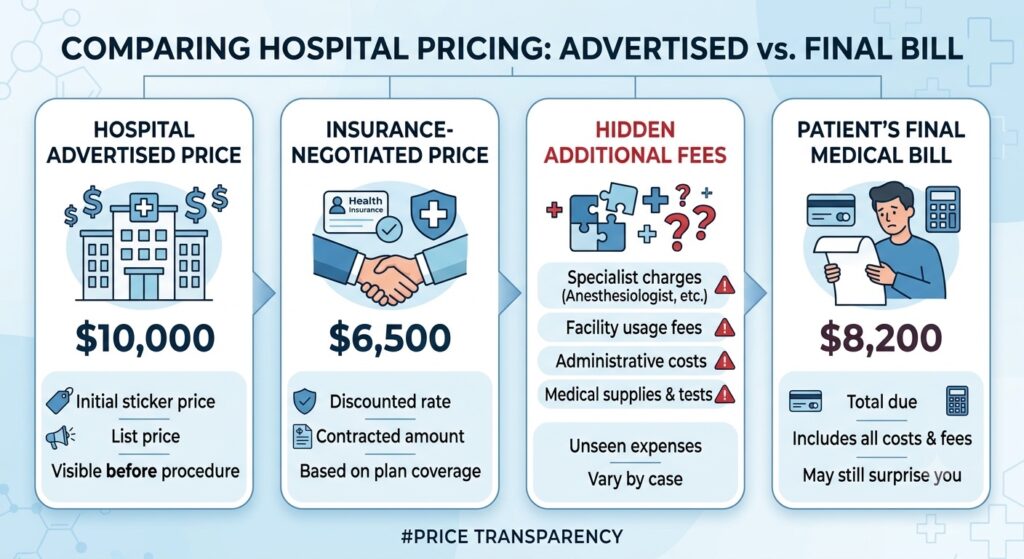
Unfortunately, healthcare prices don’t work like prices at a grocery store.
A carton of milk has one price printed on the shelf.
A medical procedure might have several different prices.
There can be:
- The hospital’s official list price
- A discounted cash price
- A price negotiated with one insurance company
- A different price negotiated with another insurance company
- A minimum negotiated price
- A maximum negotiated price
- A patient’s final out-of-pocket cost
That means two people receiving the exact same procedure at the exact same hospital could potentially face very different costs.
And that is where medical billing transparency gets messy.
The American Hospital Association itself acknowledged in a June 2026 fact sheet that the current price transparency framework has struggled to provide truly actionable information for patients.
In other words, simply uploading huge amounts of pricing data does not necessarily help an ordinary person answer the most important question:
“How much am I actually going to pay?”

Why Published Hospital Prices Can Still Be Confusing
Here is one of the biggest misunderstandings about hospital price transparency.
A hospital can publish pricing information without making healthcare costs genuinely easy to understand.
Think about it this way.
Imagine a supermarket publishing a spreadsheet containing 100,000 products.
Technically, the supermarket has disclosed its prices.
But what if the file is difficult to search?
What if products have complicated identification codes instead of familiar names?
What if the price you pay depends on which credit card you use?
What if several additional fees appear after checkout?
Would you call that transparent?
Probably not.
Yet this is similar to what patients can experience when trying to understand hospital prices.
Hospitals may publish massive machine-readable files designed primarily for computers and data analysts. Even when patients can access those files, understanding them can be difficult.
And knowing the hospital’s negotiated price still might not tell you your final bill.
Your actual cost can depend on:
- Your insurance company
- Your specific insurance plan
- Your deductible
- Your copayment
- Your coinsurance
- Whether every medical provider involved is in-network
- Additional services performed during treatment
- Separate professional fees
For teenagers or anyone unfamiliar with insurance terminology, here’s the easiest way to understand those words.
A deductible is the amount you may have to pay before your insurance starts covering certain costs.
A copayment is usually a fixed amount you pay for a service.
Coinsurance means you pay a percentage of the medical cost.
And in-network means a doctor or hospital has a pricing agreement with your insurance company.
All these factors can make the real cost of surgery in the US much harder to predict than consumers might expect.
The Difference Between “Price Disclosure” and Real Transparency
This is probably the most important point in the entire debate.
Disclosure and transparency are not the same thing.
Disclosure means information exists somewhere.
Transparency means ordinary people can find it, understand it, compare it, and use it to make decisions.
That distinction matters.
CMS strengthened its hospital price transparency requirements for 2026 partly because the government wants pricing information to become more standardized and useful.
The updated requirements include changes intended to improve the accuracy and comparability of hospital pricing data.
According to CMS, enforcement of these updated requirements began April 1, 2026.
The federal government’s message is becoming increasingly clear:
Hospitals should not simply publish numbers.
The information needs to become more meaningful for patients.
The US Department of Health and Human Services explained the goal in late 2025 when announcing the updated rules. The changes were designed to require hospitals to provide more useful pricing information rather than unclear estimates and inconsistent data.
That is an important shift.
But changing regulations is one thing.
Changing the actual patient experience is another.
Hidden Hospital Fees: Why the Final Bill Can Still Be a Shock
One of the most frustrating parts of American healthcare is the possibility of receiving charges patients did not clearly expect.
These are often described by consumers as hidden hospital fees.
For example, a patient might research the price of a medical procedure.
They check the hospital.
They check their insurance.
They even ask for an estimate.
Everything seems fine.
Then the bills arrive.
There might be a hospital facility charge.
A surgeon’s bill.
An anesthesiologist’s bill.
A radiologist’s bill.
Laboratory charges.
Medical equipment costs.
Medication charges.
Suddenly, one medical procedure has created several separate bills.
This does not automatically mean the hospital has violated federal law.
Healthcare billing is genuinely complicated, and different organizations or medical professionals may bill separately.
However, from the patient’s perspective, the result can feel incredibly confusing.
That frustration appears regularly in online communities.
In Reddit communities focused on personal finance and hospital bills, patients frequently describe receiving bills they did not expect or struggling to understand why a relatively short medical visit resulted in a large charge.
One recent discussion in the HospitalBills community described a parent receiving a bill of hundreds of dollars after insurance for a short pre-procedure consultation.
Another popular discussion warned patients about unexpected bills involving out-of-network medical providers.
These individual stories are anecdotes, not scientific evidence about the entire American healthcare system.
But they are useful because they show the emotional reality behind the policy debate.
Patients often do not feel like healthcare consumers.
They feel like people trying to solve a financial puzzle after receiving treatment.
What Happened to the Affordable Care Act Price Rules?
The Affordable Care Act helped create the legal foundation for federal hospital price transparency requirements.
Section 2718(e) of the Public Health Service Act, which was added by the Affordable Care Act, requires hospitals to establish and make public lists of standard charges.
Federal regulators later developed more detailed requirements.
Since January 1, 2021, hospitals have been required under the federal Hospital Price Transparency Rule to publish certain pricing information.
The rules have continued evolving.
The 2026 changes are part of the government’s ongoing effort to make hospital pricing information more consistent and useful.
But enforcement remains important.
A rule only works if hospitals follow it and regulators respond when they do not.
Recent reporting in July 2026 showed that several healthcare facilities in Illinois had addressed price transparency issues after receiving warnings about possible penalties.
Some hospitals said their problems involved technical formatting issues rather than missing or inaccurate pricing information.
That detail is important.
Not every compliance warning proves that a hospital was intentionally hiding prices.
Sometimes the issue can involve file formats, technical standards, incorrect identifiers, or other administrative problems.
This is why discussions about hospital price transparency need nuance.
There is clearly a transparency problem.
But claiming that every hospital with a compliance issue is deliberately deceiving patients would go beyond the available evidence.
The Real Cost of Surgery in the US: Why One Price Is Almost Impossible
Suppose you need knee surgery.
Naturally, you want to know the price.
You search online and find the hospital’s pricing information.
Problem solved?
Not necessarily.
The hospital price might cover the facility.
But what about the surgeon?
The anesthesiologist?
Medical imaging?
Laboratory tests?
Prescription drugs?
Physical therapy?
Follow-up appointments?
And how much of the total cost will your insurance actually cover?
This is why searching for the real cost of surgery in the US can be so frustrating.
There may not be one simple number.
For patients, the most useful information is usually not the hospital’s maximum price or official list price.
It is the estimated amount they personally will have to pay.
That number is known as the out-of-pocket cost.
Unfortunately, calculating it can require information from the hospital, doctors, and insurance company.
The system places a significant burden on patients to ask the right questions.
And many people do not even know which questions they should ask.
Patient Rights and Medical Billing: What Can You Actually Do?
Understanding your patient rights regarding medical billing can make a major difference.
The No Surprises Act provides federal protections against certain unexpected medical bills.
The law generally protects patients from specific types of surprise bills involving emergency services and certain out-of-network providers at in-network facilities.
However, patients should still carefully review their bills and insurance statements.
Here are some practical steps.
First, ask for a cost estimate before scheduled medical care.
Ask the hospital and healthcare providers whether they are in your insurance network.
Second, contact your insurance company.
Do not assume that receiving treatment at an in-network hospital automatically answers every billing question.
Third, request an itemized bill.
An itemized bill shows individual charges instead of presenting only one large number.
Fourth, compare the hospital bill with your Explanation of Benefits, commonly called an EOB.
An EOB is not a bill.
It is a document from your insurance company explaining what the provider charged, what insurance covered, and what you may owe.
Finally, question charges you do not understand.
A confusing medical bill should not automatically be ignored, but patients can contact the provider’s billing department and their insurance company for clarification.
Why Don’t Americans Simply Compare Hospital Prices?
This question appears frequently in debates about US healthcare costs in 2026.
If hospitals publish prices, why don’t patients simply shop around?
The answer is that healthcare is not always a normal consumer market.
You can compare laptop prices for several weeks.
You can wait for a discount on a television.
You can visit three supermarkets before buying groceries.
Medical care can be different.
A person having a heart attack is not going to compare hospital spreadsheets.
Someone diagnosed with cancer may prioritize finding the right specialist over finding the cheapest provider.
Even scheduled procedures can be difficult to compare because insurance networks, deductibles, and separate medical providers affect the final cost.
This is also reflected in online discussions about healthcare transparency.
Some Reddit users argue that “shoppable” medical services should work more like normal consumer markets.
Others point out that healthcare prices are too complicated for simple comparison shopping.
Both arguments reveal an important truth.
Price transparency can help.
But transparency alone cannot solve every problem in the American healthcare system.
So, Are Hospitals Finally Becoming More Transparent?
The answer is complicated.
Yes, federal rules are becoming stronger.
Yes, hospitals face increasingly detailed requirements.
Yes, CMS is trying to improve the quality and usefulness of pricing data.
But no, this does not mean the average American patient can always predict the final cost of medical care.
That is the gap between legal compliance and real-world transparency.
A hospital can publish millions of pricing records.
But if patients still cannot answer the question, “How much will I personally pay?” then the system has more work to do.
The good news is that the federal government appears to recognize this problem.
The 2026 Hospital Price Transparency updates focus more attention on standardized, accurate, and consumer-usable pricing information.
The bigger question is whether enforcement and future reforms will finally make healthcare prices understandable for ordinary Americans.
Conclusion: Medical Billing Transparency Is About More Than Numbers
The debate over hospital price transparency is sometimes presented as a simple argument.
Hospitals should publish their prices.
Problem solved.
But the reality of medical billing is much more complicated.
Publishing data is only the first step.
Patients need information they can actually understand.
They need realistic estimates.
They need clearer explanations of insurance costs.
They need protection from certain unexpected medical bills.
And most importantly, they need to know what they are likely to pay before receiving non-emergency treatment whenever possible.
The United States has made progress toward greater medical billing transparency.
The Affordable Care Act helped establish the legal foundation.
The Hospital Price Transparency Rule expanded public pricing requirements.
The No Surprises Act created important protections against certain unexpected medical bills.
And the updated 2026 CMS requirements are intended to make hospital pricing information more accurate and useful.
But the basic problem remains.
Healthcare prices can be public without being truly clear.
Until ordinary patients can easily understand and compare their expected costs, hospital price transparency will remain a work in progress.
And for millions of Americans opening medical bills at their kitchen tables, that progress cannot come soon enough.
Sources
Centers for Medicare & Medicaid Services (CMS) — Hospital Price Transparency
CMS Hospital Price Transparency
US Department of Health and Human Services — 2026 Hospital Payment and Transparency Changes
HHS Hospital Price Transparency Announcement
American Hospital Association — Hospital Price Transparency: Current Landscape
AHA Hospital Price Transparency Fact Sheet
Recent Illinois Hospital Price Transparency Reporting
Reddit — HospitalBills Community Discussion
Reddit Hospital Billing Discussion
Reddit — Healthcare Price Transparency Discussion
Reddit Healthcare Transparency Discussion
Reddit — Surprise Medical Billing Discussion
Reddit Surprise Medical Billing Discussion
Disclaimer: This content is for informational purposes only and is not intended as medical advice, diagnosis, or treatment. Always seek the advice of a qualified healthcare provider with any questions you may have regarding a medical condition.