
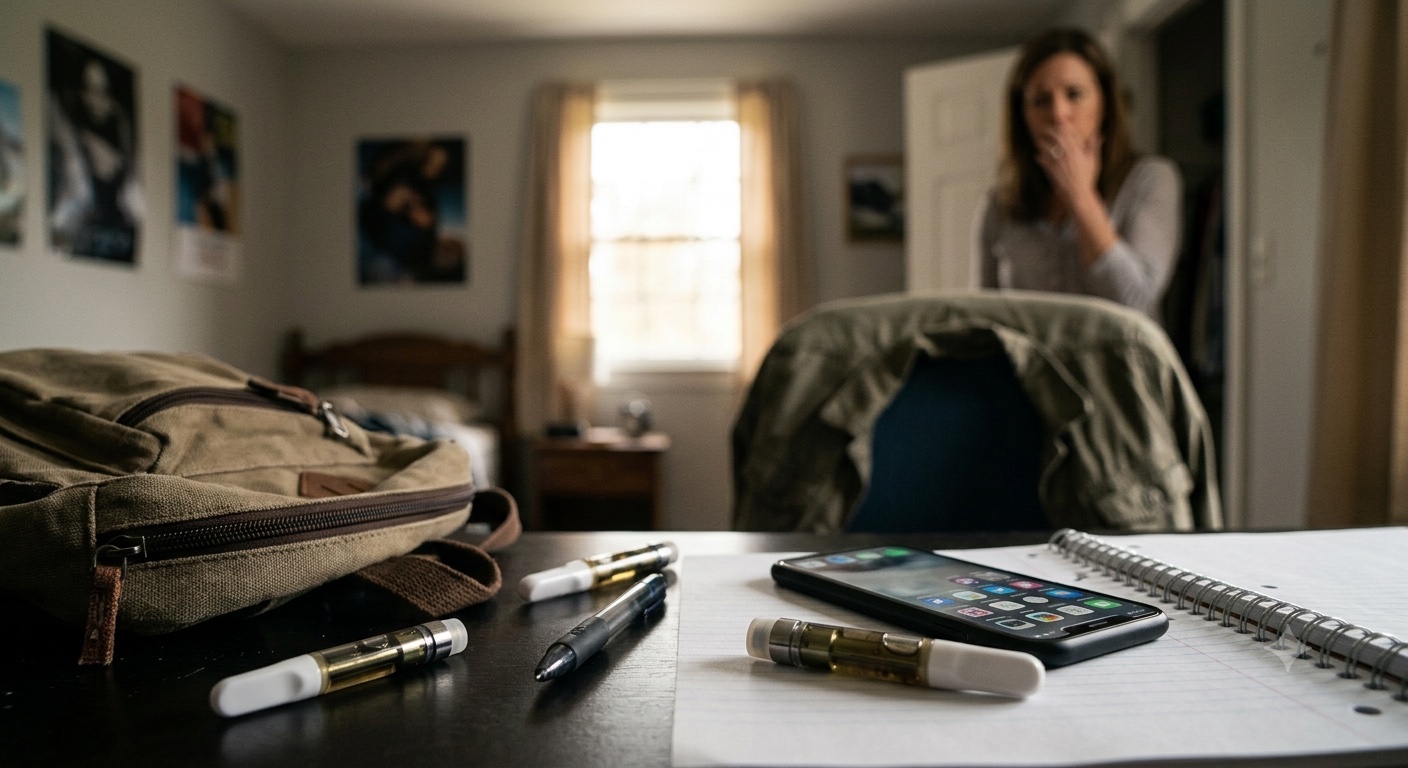

Synthetic cannabis is becoming harder to recognize, easier to hide, and potentially far more unpredictable than the marijuana many parents think they know.
A small vape cartridge can look harmless.
It may resemble an ordinary nicotine vape. It may smell sweet. It may even be sold as “THC” or described as a cannabis alternative.
But what is actually inside?
That is the question parents should be asking.
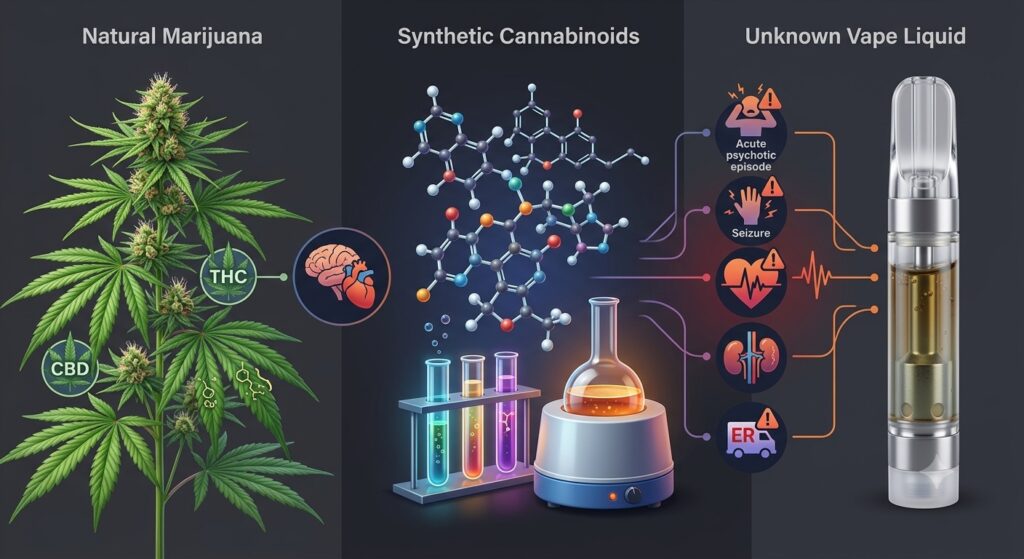
Synthetic cannabinoids are not simply stronger versions of marijuana. They are laboratory-made chemicals designed to affect some of the same receptors in the brain as THC, the main psychoactive ingredient in cannabis.
The problem is that the effects can be dramatically different.
And as drug products continue to change, the familiar image of “synthetic weed” as a colorful packet of dried herbs is becoming dangerously outdated.
What Is Synthetic Marijuana?
First, we need to clear up a common misunderstanding.
Synthetic marijuana is not marijuana grown in a laboratory.
The more accurate term is synthetic cannabinoids.
These are human-made chemicals that interact with cannabinoid receptors in the brain. Those receptors are also affected by THC.
That sounds similar to regular cannabis.
But here is the important difference.
The chemicals found in synthetic cannabis products can have very different strengths and effects. The contents of illegal products may also be difficult or impossible for users to know before taking them.
Synthetic cannabinoids have historically been sold under names such as Spice and K2.
Some products were sprayed onto dried plant material and smoked.
But synthetic cannabinoids can also appear in concentrated liquid forms, including liquids associated with vaping devices.
That change matters.
A colorful packet of “herbal incense” may raise questions.
A small vape cartridge can easily disappear into a backpack or pocket.
Why Synthetic Cannabis Vapes Are So Concerning
Imagine two vape cartridges sitting next to each other.
One contains nicotine.
Another contains THC.
The third contains an unknown synthetic cannabinoid.
Could you tell the difference just by looking?
Probably not.
That is one reason liquid THC cartridges teens may encounter deserve serious attention.
Products sold through illegal or unregulated markets do not come with the safety controls consumers would expect from legitimate products.
The label may not accurately describe the contents.
The strength may be unknown.
Different chemicals may be present.
In other words, the user may have very little idea what is actually entering the body.
This is also why calling synthetic cannabinoids “fake weed” can be misleading.
The word “fake” sounds weak or harmless.
These substances can be anything but harmless.
Synthetic Weed Side Effects Can Be Unpredictable
One of the biggest dangers is unpredictability.
According to public health authorities, reported effects associated with synthetic cannabinoids can include agitation, confusion, hallucinations, rapid heart rate, vomiting, seizures, and other serious reactions.
Why can the reaction be so different from ordinary cannabis?
Think of the brain’s receptors as locks.
THC is one key that interacts with those locks.
Synthetic cannabinoids are different keys.
Some may activate the receptors in different or more powerful ways.
That can produce effects that users were not expecting.
And there is another problem.
Illegal drug manufacturers can change the chemical formula.
That means yesterday’s product and today’s product may look similar while containing different substances.
Even two packages with the same branding may not necessarily contain identical chemicals.
For parents, this is one of the most important facts to understand.
Appearance does not tell you what is inside.
“But Aren’t Teen Drug Use Rates Going Down?”
This is a reasonable question.
Recent youth surveys have shown declines or historically low levels in some categories of adolescent substance use.
That is encouraging.
But lower overall use does not mean every drug-related risk has disappeared.
The drug market itself is changing.
New psychoactive substances can emerge quickly. Products can be mislabeled. Vaping devices can make some substances easier to conceal.
That creates a different kind of challenge.
Parents are no longer watching only for bottles, pills, powders, or the smell of marijuana.
They may also need to understand cartridges, disposable vapes, and products sold online or through informal markets.
The issue is not simply whether more teenagers are using drugs.
The issue is whether the drugs available to them are becoming harder to identify.
The “Vape Alternative Drugs” Problem
Vaping technology changed the way nicotine was consumed.
It also created a delivery system that can potentially be used for other substances.
That is where the broader vape alternative drugs problem begins.
A device itself does not tell you what chemical is inside.
Some teenagers may believe they are buying ordinary cannabis products.
Others may intentionally seek cheaper or stronger alternatives.
Either situation can become dangerous when the contents are unknown.
This is especially important because synthetic cannabinoids are part of a constantly changing category of substances often called new psychoactive substances.
That phrase sounds complicated.
The idea is actually simple.
Chemists create or modify chemicals that affect the brain.
Authorities identify and regulate them.
Then new versions may appear.
It can become a dangerous game of chemical cat and mouse.
What Online Communities Say About Synthetic Cannabis
Online discussions about synthetic cannabinoids reveal something important.
People who discuss their experiences frequently distinguish synthetic cannabis from ordinary marijuana.
Some users describe frightening or unpredictable reactions. Others warn people not to assume that products sold as cannabis alternatives will produce effects similar to natural cannabis.
Of course, Reddit posts and other community discussions are personal anecdotes.
They are not scientific evidence.
But they can still show how users themselves talk about risk.
One recurring theme is clear: many people who have experience with synthetic cannabinoids warn that the effects can be dramatically different from what inexperienced users expect.
For parents, there is a lesson here.
Fear-based lectures may not be the best starting point.
Accurate information is.
Teen Substance Abuse Trends in 2026 Are More Complicated Than They Look
Understanding teen substance abuse trends 2026 requires looking beyond a single number.
Teen drug use is not simply moving up or down.
The types of products available are changing.
Social media can spread information quickly.
Illegal sellers can market products with attractive packaging.
Vape devices can conceal substances that once would have been easier to notice.
And parents may still be looking for warning signs from 10 or 20 years ago.
That creates an information gap.
Teenagers may know more about new drug slang and products than the adults responsible for protecting them.
Closing that gap should be a priority.
Warning Signs Parents Should Know
There is no single symptom that proves a teenager has used synthetic cannabinoids.
That is important.
Parents should not jump to conclusions based on one behavior.
However, sudden and unexplained changes deserve attention.
These may include severe confusion, unusual agitation, extreme anxiety, hallucinations, vomiting, seizures, or loss of consciousness.
A sudden behavioral change combined with unknown vaping products can also be a reason to ask more questions.
If someone experiences a serious medical reaction after taking an unknown substance, emergency medical help should be contacted immediately.
Do not assume the person can simply “sleep it off.”
And if a vape cartridge or package is available, keeping it for medical professionals may help identify what was used.
How Should Parents Talk to Teenagers About Synthetic Weed?
This may be the hardest part.
Walking into a teenager’s room and shouting, “Are you doing drugs?” probably will not lead to a productive conversation.
Try starting with information instead.
You might say:
“I’ve been reading about unknown chemicals being sold in vape cartridges. Do people at your school talk about that?”
That question opens a conversation.
It does not begin with an accusation.
Parents should also explain one simple fact.
The biggest danger may not be what teenagers knowingly choose to take.
It may be what they do not know they are taking.
A cartridge sold as THC may contain something else.
A product used safely by one person may not be chemically identical to another product with similar packaging.
And a friend saying, “I tried it and I was fine,” does not prove that another cartridge is safe.
What Parents Can Do Right Now
You do not need to become a drug enforcement expert.
You do need to stay curious.
Learn what modern vape devices look like.
Talk openly about unknown cartridges and unregulated products.
Avoid exaggerated claims that teenagers can easily disprove.
Focus on the real issue: nobody can accurately judge the safety of an unknown chemical mixture by looking at the package.
Most importantly, keep the conversation going.
One awkward discussion is unlikely to solve everything.
Regular, calm conversations can make it easier for teenagers to ask for help when something goes wrong.
Final Thoughts: The Drug Threat Is Changing Faster Than Many Parents Realize
The biggest lesson from the synthetic cannabis problem is simple.
Parents cannot protect teenagers from modern drug risks using outdated information.
Synthetic cannabinoids are not simply another form of marijuana.
Unknown chemicals can appear in products that are difficult to identify, including vaping liquids.
The effects can be unpredictable.
And illegal drug markets can change faster than public awareness.
That does not mean parents should panic.
It means they should pay attention.
Learn what synthetic cannabinoids are. Understand why unknown vape cartridges can be dangerous. Talk to teenagers before a crisis happens.
Because when the contents of a tiny cartridge are impossible to identify by sight, good information may be one of the most valuable protections a family has.
Sources
U.S. Drug Enforcement Administration (DEA) – K2/Spice Information
https://www.dea.gov/factsheets/spice-k2-synthetic-marijuana
National Institute on Drug Abuse (NIDA) – Synthetic Cannabinoids
https://nida.nih.gov/research-topics/synthetic-cannabinoids-k2spice
Centers for Disease Control and Prevention (CDC) – Synthetic Cannabinoids
https://www.cdc.gov/overdose-prevention/about/synthetic-cannabinoids.html
Monitoring the Future – National Survey Results on Teen Drug Use
https://monitoringthefuture.org/
Reddit – Community Discussions About Synthetic Cannabinoids
https://www.reddit.com/search/?q=synthetic%20cannabinoids
Disclaimer: This content is for informational purposes only and is not intended as medical advice, diagnosis, or treatment. Always seek the advice of a qualified healthcare provider with any questions you may have regarding a medical condition.