


The June Heatwave has exposed an uncomfortable truth: while many of us escape the heat by turning on the air conditioner, millions of delivery and outdoor workers have no choice but to keep working in dangerous temperatures.
You order a package.
A few hours later, someone walks up to your door carrying it.
Simple, right?
But during an extreme heatwave, that short walk to your front door may be just one of hundreds a delivery worker makes in a single day.
Inside a hot delivery van, on a bicycle, or walking across sun-baked pavement, there may be little time to cool down.
And as recent heatwaves have shown, this is no longer just about feeling uncomfortable.
It is becoming a serious public health and workers’ rights issue.
The June Heatwave Was More Than Just “Hot Weather”
The summer of 2026 has already provided a frightening preview of what extreme heat can do.
During the June Heatwave in Europe, hospitals reported a sharp increase in patients suffering from dehydration, heart problems, kidney problems, and other conditions linked to extreme temperatures.
At Paris-Saclay Hospital, heat-related emergency patients began arriving in large numbers around June 20. The head of the emergency department described the increase as lasting about seven intense days.
The problem was not limited to France.
The World Health Organization’s European office reported that around 60% of hospital admissions following emergency visits during the heatwave involved people aged 75 or older.
In France, preliminary government data showed deaths during the week of June 22 to June 28 were 29% higher than the previous week.
These numbers help explain why an Emergency Room Surge during extreme heat should concern everyone.
Heat does not simply make people sweaty and tired.
It can overwhelm the human body.
And for people who must work outside, the danger can be even greater.
Why Delivery Workers Face a Different Kind of Risk
Most people have a simple solution when temperatures become dangerous.
Go inside.
Turn on the air conditioning.
Drink some water.
Rest.
Delivery workers often cannot do that.
Their job requires them to move constantly between vehicles, sidewalks, buildings, parking lots, and customers’ homes.
Some workers spend hours inside vehicles that can become extremely hot.
Others deliver food or packages on bicycles and motorcycles, leaving them directly exposed to sunlight and hot pavement.
Even vehicles with air conditioning do not completely solve the problem.
Drivers may leave their vehicles dozens or hundreds of times during a shift.
Every delivery means stepping back into the heat.
This repeated exposure can gradually raise the body’s temperature and increase the risk of Heat-Related Illness.
That is why Outdoor Workers Protection cannot simply mean telling workers to “drink more water.”
The problem is much bigger.
Then What Is Heat-Related Illness?
Heat-Related Illness is a general term for health problems caused when the body becomes too hot.
The mildest symptoms can include dizziness, headache, heavy sweating, weakness, and muscle cramps.
More serious cases can lead to heat exhaustion.
The most dangerous condition is heat stroke.
Heat stroke happens when the body loses its ability to control its temperature.
Without fast medical treatment, it can cause organ damage or death.
The scary part?
Workers do not always recognize how serious the situation has become.
A person may think they are simply tired after a long shift.
But headache, confusion, nausea, unusual weakness, or dizziness can be warning signs that the body is struggling with extreme heat.
This is why Extreme Heat Safety policies matter.
Workers need more than advice.
They need actual protection.
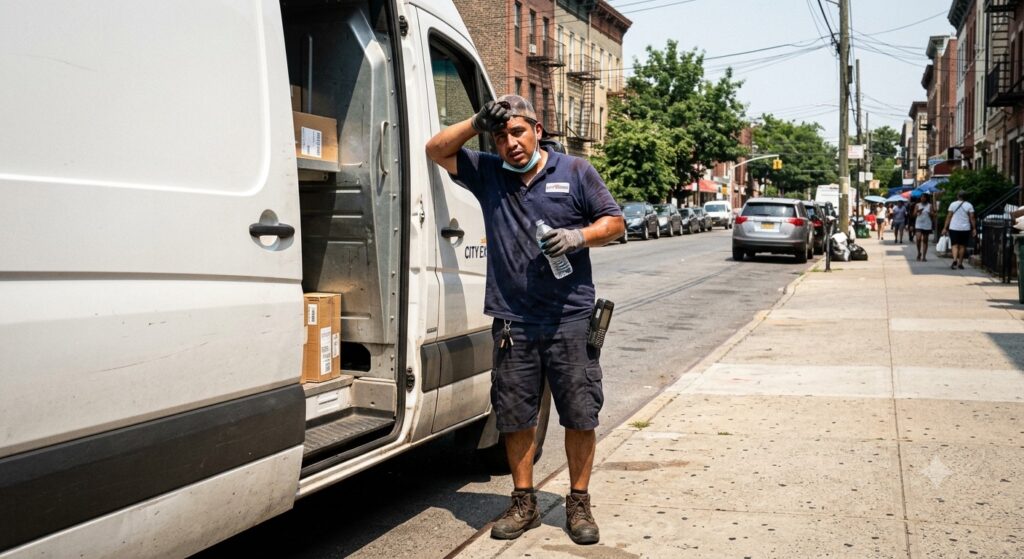
“Just Take More Breaks” Sounds Easy. But Is It?
This is one of the most common arguments.
If workers feel hot, why don’t they simply stop working?
The answer is complicated.
Many delivery workers operate under strict schedules, performance expectations, delivery targets, or economic pressure.
Gig workers may face another problem.
If they stop working, they may stop earning money.
A Reddit user discussing food delivery work during extreme heat described temperatures in the 90s Fahrenheit combined with humidity of 70% to 80%.
The driver explained that working in a hot vehicle with the windows down and fans blowing warm air became so exhausting that continuing to work barely felt worthwhile.
In another Reddit discussion about delivery drivers without air conditioning, users pointed toward an important issue: employers need proper heat risk assessments and must actually follow safety procedures.
These comments are personal experiences, not scientific studies.
But they reveal something statistics can miss.
Workers often find themselves choosing between income and health.
And that raises a bigger question.
Should Extreme Heat Safety really depend on individual workers making that choice?
Some Companies Are Already Changing How They Handle Heat
There are signs of progress.
During Europe’s 2026 heatwave, Reuters reported that companies introduced new measures to protect workers.
In Germany, DHL provided cooling kits to more than 111,000 postal workers.
Some construction companies moved working hours to earlier in the morning.
Other businesses provided additional water and fruit.
UPS has also been upgrading delivery vehicles with air conditioning while providing workers with fans, cooling equipment, electrolyte drinks, and other tools designed to reduce heat risks.
These measures show that protecting workers is possible.
But they also reveal a major weakness in the current system.
Protection can depend heavily on where someone works.
One company may provide cooling equipment and mandatory breaks.
Another worker may receive little more than advice to stay hydrated.
Health protection should not depend on luck.
What Stronger Outdoor Workers Protection Could Look Like
Protecting workers from extreme heat does not require complicated technology.
Many solutions are surprisingly simple.
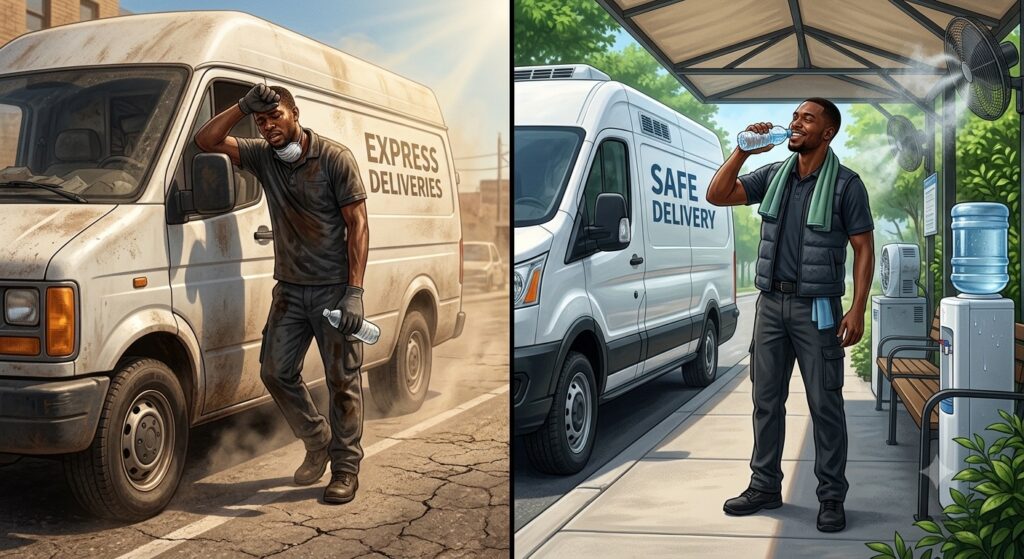
Workers need guaranteed access to drinking water.
They need shaded or air-conditioned rest areas.
They need additional breaks when temperatures become dangerous.
Work schedules can be moved away from the hottest hours of the afternoon.
Employers can also provide training so workers recognize the early symptoms of Heat-Related Illness.
Most importantly, workers should be able to report dangerous conditions without worrying about losing income or facing punishment.
These ideas are increasingly becoming part of international discussions.
European trade unions representing millions of workers are pushing for stronger, legally enforceable protections against heat stress.
Proposals include heat risk assessments, guaranteed access to water and shade, adjusted working hours, and mandatory rest periods.
The basic idea is simple.
Extreme weather requires different workplace rules.
Public Cooling Centers Matter Too
Worker protection cannot stop at the workplace.
Cities also need stronger systems to protect Vulnerable Populations.
This includes older adults, homeless people, people with chronic illnesses, low-income families, and workers who spend most of the day outdoors.
Public Cooling Centers can provide air-conditioned spaces where people can temporarily escape dangerous temperatures.
But simply opening these centers is not enough.
People need to know where they are.
They need transportation to reach them.
Opening hours must match the times when extreme heat is most dangerous.
And workers need to be allowed enough time to actually use them.
A cooling center that an exhausted delivery driver cannot visit during a shift offers little practical protection.
The Bigger Problem: Climate Change Impacts
There is another reason this discussion cannot wait.
Extreme heat is becoming a larger challenge as the climate changes.
The World Health Organization has warned that recent European heatwaves should be viewed as preparation for what countries may increasingly face in the future.
That does not mean every hot day is caused by climate change.
Weather naturally changes from day to day and year to year.
But the long-term trend is clear: human-caused climate change is increasing the frequency and intensity of dangerous heat in many regions.
That means the June Heatwave is not simply a temporary workplace problem.
It is part of a much larger challenge.
Our cities, hospitals, workplaces, transportation systems, and labor laws were often designed for a cooler climate.
Now they must adapt.
But Would Stronger Rules Hurt Businesses?
This is a reasonable question.
More breaks, cooling equipment, and schedule changes can cost money.
Some businesses may worry that stricter heat protections will reduce productivity.
But there is another side to that calculation.
Workers suffering from heat exhaustion cannot work effectively.
Serious Heat-Related Illness can require emergency medical treatment.
Heat can also increase fatigue and reduce concentration, creating additional workplace risks.
In other words, ignoring extreme heat also has a cost.
The real question is not whether businesses can afford worker protections.
It is whether society can afford to continue treating increasingly dangerous temperatures as normal working conditions.
Customers Have a Role Too
Governments and employers carry the biggest responsibility.
But customers can help.
During extreme heat, consider leaving cold water for delivery workers when possible.
Be patient if deliveries take longer.
Avoid unnecessary complaints when dangerous weather slows down service.
And remember that “fast delivery” is not created by an app.
There is a real person carrying that package to your door.
Small acts of kindness cannot replace strong labor protections.
But they can remind us why those protections matter.
Final Thoughts: No Delivery Is Worth a Human Life
The June Heatwave has made one thing increasingly difficult to ignore.
Extreme heat is becoming a workplace safety issue.
The Emergency Room Surge seen during recent heatwaves shows what can happen when human bodies are pushed beyond their limits.
Delivery workers, construction workers, farm workers, and other outdoor employees face risks that people inside air-conditioned buildings may rarely see.
That is why Outdoor Workers Protection and Delivery Workers Health Rights deserve greater attention.
Workers need water.
They need rest.
They need access to shade and cooling.
They need clear Extreme Heat Safety rules that protect them before they collapse, not after an ambulance arrives.
Public Cooling Centers and stronger support for Vulnerable Populations must also become part of how cities prepare for increasingly dangerous summers.
Climate Change Impacts will continue to test our workplaces and communities.
The question is whether our protections will change fast enough.
The next time a package arrives during a brutal heatwave, take a moment to look beyond the cardboard box.
Someone had to carry it through the heat.
And no promise of fast delivery should ever be more important than that person getting home safely.
Sources
- Associated Press — Deaths surged 29% in France during week of record heat, health agency says
https://apnews.com/article/86e0a05e49a6ca7317e86b16b4296453 - World Health Organization Europe — Get prepared: Current European Region heatwaves are a dress rehearsal
https://www.who.int/europe/news/item/30-06-2026-statement—get-prepared–current-european-region-heatwaves-are-a-dress-rehearsal - Reuters — From cool boxes to dawn starts, Europe Inc adapts to heatwave
https://www.reuters.com/business/environment/cool-boxes-dawn-starts-europe-inc-adapts-heatwave-2026-06-23/ - The Guardian — Unions in Europe press for new worker protections to counter heat stress
https://www.theguardian.com/environment/2026/jul/08/unions-europe-worker-protections-heat-stress-climate-crisis - Los Angeles Times — Hospitals in Europe are gearing up for the next heat wave
https://www.latimes.com/environment/story/2026-07-01/hospitals-in-europe-are-gearing-up-for-next-heat-wave-armed-with-lessons-from-this-one - Reddit / UberEatsDrivers — I can’t work in the extreme heat. Any tips from people also delivering in hot climates?
https://www.reddit.com/r/UberEatsDrivers/comments/14u6oiu/i_cant_work_in_the_extreme_heat_any_tips_from/ - Reddit / drivingUK — Delivery drivers without AC
https://www.reddit.com/r/drivingUK/comments/169tv3x/delivery_drivers_without_ac/
Disclaimer: This content is for informational purposes only and is not intended as medical advice, diagnosis, or treatment. Always seek the advice of a qualified healthcare provider with any questions you may have regarding a medical condition.