


Losing muscle as you age isn’t just about looking “toned.” New research shows muscle loss (sarcopenia) is tightly linked to insulin resistance and metabolic syndrome — and cardio alone can’t reverse it. Here’s what actually helps.
You’ve probably heard someone say, “I eat the same as I did in my 20s, but the weight just won’t come off anymore.” Or maybe that someone is you.
Here’s the thing: it’s usually not about willpower. It’s about muscle. Specifically, it’s about how much muscle you’re quietly losing every year — and how that loss messes with the way your body handles blood sugar.
This isn’t just a “get toned for summer” story. Researchers are increasingly treating muscle mass as a health marker, not a beauty one. Let’s break down why, in plain English.
Wait, what even is “sarcopenia”?
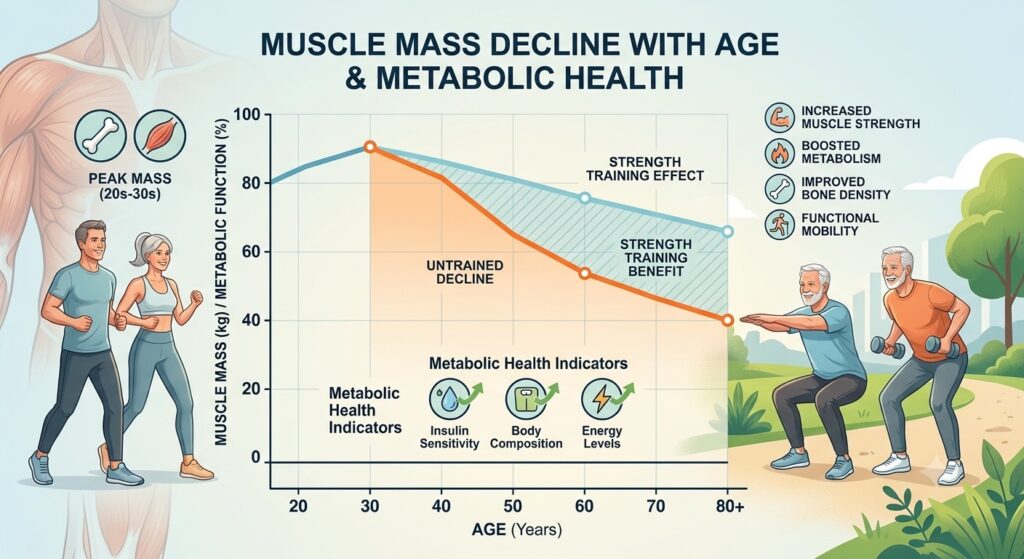
Sarcopenia is just a fancy medical word for age-related muscle loss. It sounds scary, but the basic idea is simple: starting in your 30s, your body naturally starts losing muscle if you don’t do anything to maintain it, and the pace speeds up significantly after 40. One nutrition expert estimated the loss at roughly 3 to 5 percent of muscle mass per decade after age 30, and by your 40s that decline tends to pick up speed.
Less muscle means your resting metabolism — the calories you burn just existing, breathing, and sitting on the couch — drops too. That’s a big reason why muscle mass affects weight loss after 40 so directly: fewer muscle cells means fewer “engines” burning fuel around the clock, even when you’re not exercising.
So how does losing muscle actually cause weight and blood sugar problems?
Here’s where it gets interesting — and where a lot of people get confused. Muscle isn’t just for lifting heavy things. It’s actually your body’s biggest storage tank for glucose (blood sugar).
When you eat carbs, your body releases insulin, which acts like a key that unlocks your muscle cells so glucose can go inside and get used for energy. Muscle tissue soaks up a huge share of the sugar you eat. The more muscle you have, the more “storage space” you have for that sugar, and the easier it is for your body to keep blood sugar steady.
Now flip it around. When muscle mass shrinks, there’s less storage space. Glucose builds up in the bloodstream instead of getting absorbed efficiently, so your pancreas has to pump out more and more insulin to compensate. Over time, your cells stop responding properly to all that insulin — this is what’s called insulin resistance.
Scientists studying this exact relationship describe insulin resistance as one of the most important connectors between muscle loss and metabolic syndrome, since it directly shapes how these two conditions interact and reinforce each other over time. In plain terms: low muscle mass and insulin sensitivity are a two-way street — less muscle worsens insulin resistance, and insulin resistance, in turn, makes it harder to build or keep muscle. It becomes a loop that’s hard to break out of on its own.
There’s actual biology behind this too. Researchers have found that as muscle shrinks, fat can start infiltrating the muscle tissue itself (this is called “myosteatosis,” basically fatty muscle), and that fat buildup inside muscle cells interferes with how well those cells respond to insulin. So it’s not just “less muscle equals less storage” — the quality of the remaining muscle also gets worse, which compounds the problem.
The “sarcopenic obesity” trap nobody talks about
Here’s a twist that surprises a lot of people: you can be both overweight and have dangerously low muscle mass at the same time. This combo has an actual medical name — sarcopenic obesity — and it’s considered a particularly high-risk state because you get the metabolic downsides of low muscle and the downsides of excess fat, stacked on top of each other.
Researchers reviewing this condition found that people with sarcopenic obesity face a higher risk of health complications compared to people who are only obese or only sarcopenic on their own. That’s a big deal, because it means the scale alone can be misleading. Someone who “looks fine” or even underweight on paper could still have very little muscle and a lot of visceral fat hiding underneath — a body composition that’s arguably riskier than a higher number on the scale with decent muscle mass.
Why does everyone say “just eat less” doesn’t work after 40?
If you’ve spent any time in weight-loss forums or Reddit threads, you’ve probably seen this exact frustration repeated over and over: cutting calories used to work, and now it just… doesn’t. People online frequently describe the same pattern — dieting harder for smaller results, feeling more fatigued, and hitting stalls faster than they did in their 20s.
Health writers covering this trend point out that under-eating without enough protein or resistance training can make things worse, not better: when you’re in a big calorie deficit without enough muscle-protecting habits, your body may break down muscle tissue for energy. Less muscle then means an even slower metabolism — which is exactly the outcome most people are trying to avoid. It’s a really common can’t lose weight, muscle loss reason that rarely gets explained clearly in mainstream diet advice, which tends to focus only on calories in vs. calories out.
Okay but why doesn’t cardio fix this?
Cardio (running, cycling, swimming) is genuinely great for your heart and can burn calories in the moment. But here’s the catch: cardio alone doesn’t build or preserve much muscle. If muscle loss is the root problem driving insulin resistance, then a workout routine that’s 100% cardio and 0% strength work is only addressing part of the puzzle.
This is where resistance training and insulin resistance reversal research gets exciting. A meta-analysis pooling results from multiple randomized controlled trials found that resistance training led to meaningful improvements in insulin-related markers in middle-aged and older adults, including drops in fasting insulin levels and improved HOMA-IR (a standard measure of insulin resistance), alongside actual increases in muscle mass and strength. Other reviews focused specifically on older adults found similar improvements in insulin sensitivity markers after periods of structured resistance exercise.
That doesn’t mean cardio is useless — it’s genuinely valuable for heart health and endurance. But if your main goal is fixing the muscle-insulin resistance loop, strength training earns a permanent seat at the table. Think of resistance training as the piece that directly rebuilds your body’s glucose “storage capacity,” while cardio supports your cardiovascular system alongside it. The two work best as a team, not as substitutes for each other.

So what should you actually do?
You don’t need to become a powerlifter. A few evidence-backed starting points:
- Add resistance training 2–3x a week. Bodyweight squats, push-ups, resistance bands, or light dumbbells all count. Consistency matters more than intensity when you’re starting out.
- Prioritize protein. Muscle needs raw material to rebuild itself, especially if you’re in any kind of calorie deficit.
- Don’t rely on cardio alone if your goal is metabolic health. Keep it in your routine, but pair it with strength work.
- Watch for the “skinny but weak” trap. A number on the scale doesn’t tell you your muscle-to-fat ratio. If you can, track strength progress (can you lift a bit more than last month?) as a proxy for muscle health.
The bottom line
Muscle mass isn’t just about how your arms look in a T-shirt. It functions almost like an organ for blood sugar control — and when it shrinks, your risk for insulin resistance, sarcopenic obesity, and metabolic syndrome climbs right along with it.
If weight loss has felt impossible since you turned 40, the missing piece might not be more dieting — it might be more muscle.
Sources
- Frontiers in Nutrition (2026) — Association between estimated glucose disposal rate and metabolic syndrome in older adults with sarcopenia
- Diabetology & Metabolic Syndrome, Springer Nature (2023) — Causal relationship between insulin resistance and sarcopenia
- Journal of the Endocrine Society, Oxford Academic (2024) — Low Handgrip Strength (Possible Sarcopenia) With Insulin Resistance Is Associated With Type 2 Diabetes Mellitus
- JMIR Aging (2025) — Association of Insulin Resistance, Sarcopenia, and Risk of Cardiovascular Disease
- PMC / MDPI (2024) — Sarcopenia and Diabetes: A Detrimental Liaison of Advancing Age
- PubMed — Insulin resistance and sarcopenia: mechanistic links between common co-morbidities
- ScienceDirect (2025) — Resistance training enhances metabolic and muscular health and reduces systemic inflammation in middle-aged and older adults with type 2 diabetes: a meta-analysis
- ScienceDirect (2021) — Effects of resistance training on insulin sensitivity in the elderly: A meta-analysis of randomized controlled trials
- AOL / Hearst — The 8 Best Ways to Lose Weight After 40
- Attraction Flow (Substack) — Why “Just Eat Less” Doesn’t Work After 40 — The Metabolic Trap No One Talks About
- WebMD — Fighting 40s Flab
Note: This article is for general informational purposes and isn’t a substitute for personalized medical advice. Anyone with concerns about blood sugar, weight, or muscle loss should talk to a doctor or registered dietitian.