

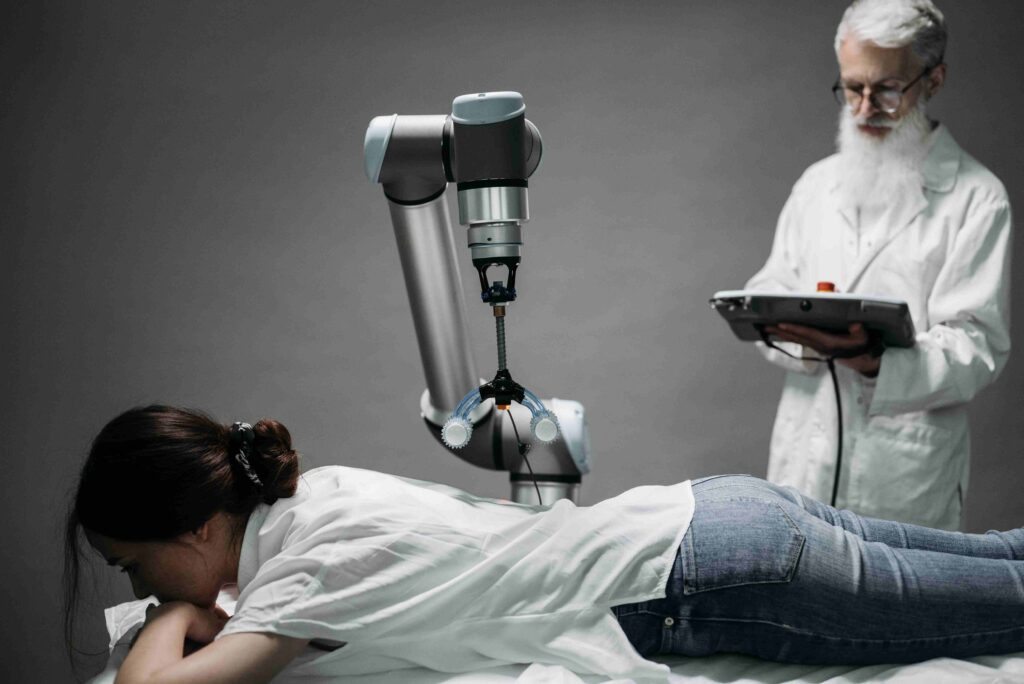
Doctors aren’t leaving medicine because they suddenly stopped caring about patients. Many are leaving because they are drowning in paperwork, administrative tasks, staffing shortages, and chronic exhaustion.
Now, a new generation of Healthcare AI tools is being marketed as a solution.
The big question is whether AI can actually reduce Medical Burnout, or if it’s simply adding another layer of complexity.
A Growing Crisis Few Patients Fully See
Most people imagine a physician’s day as diagnosing illnesses, treating patients, and making critical medical decisions.
The reality often looks very different.
Many doctors spend hours every day dealing with electronic health records, insurance documentation, prior authorizations, compliance requirements, and endless forms. What many patients never see is the amount of work happening after clinic hours.
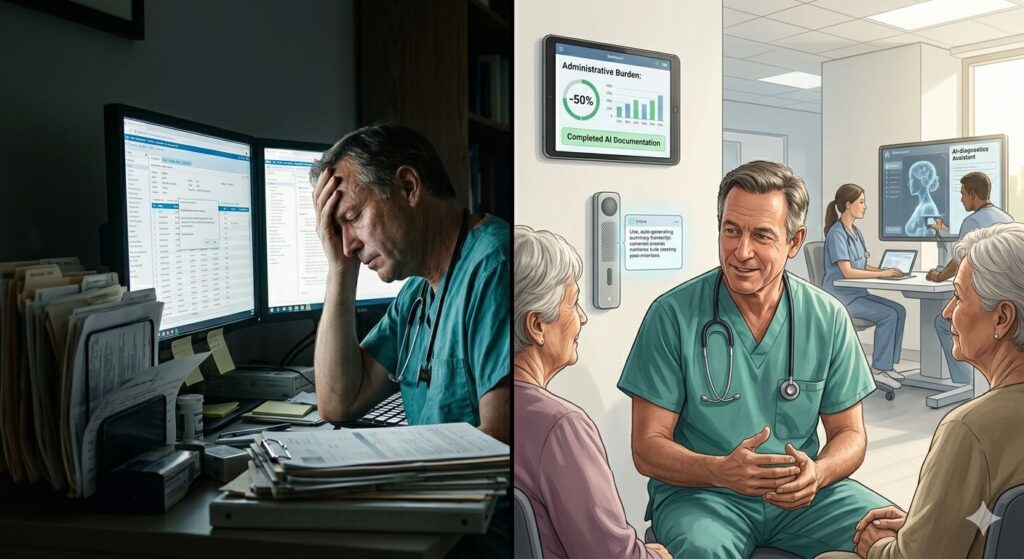
Researchers even have a term for it: “pajama time.” That’s the time physicians spend finishing documentation at night after their families have gone to bed.
And that burden is becoming one of the biggest drivers of Medical Burnout.
According to the 2025 Canadian Medical Association National Physician Health Survey, physicians continue to report excessive workloads, exhaustion, and burnout, with some reducing clinical hours or considering leaving practice altogether.
This isn’t just a Canadian issue.
Across North America, Europe, and parts of Asia, healthcare systems are struggling with a growing Healthcare Staff Shortage while simultaneously facing rising patient demand.
The result?
Fewer doctors are available, and the ones who remain are often carrying heavier workloads.
The Administrative Burden Nobody Signed Up For
Ask physicians what frustrates them most, and many won’t say difficult diagnoses.
They’ll say paperwork.
The modern healthcare system requires an enormous amount of documentation. Every patient interaction generates notes, billing requirements, coding requirements, legal records, compliance records, and communication records.
This growing Doctor Administrative Burden has become one of the most discussed topics in healthcare forums and physician communities.
In multiple physician discussions online, doctors describe spending evenings reviewing charts and correcting documentation instead of recovering from the workday. Some report that charting consumes nearly as much energy as patient care itself.
One physician commenting on an AI scribe discussion summarized it simply:
“They make me less tired at the end of the day.”
That statement may sound small.
But in a profession facing widespread burnout, being “less tired” can make a huge difference.
Why AI Suddenly Became Healthcare’s Favorite Buzzword
A few years ago, most discussions around AI in Medicine focused on diagnostics.
Could AI read X-rays?
Could AI detect cancer?
Could AI outperform specialists?
Today, many healthcare executives are focused on something much less glamorous:
Documentation.
Instead of replacing doctors, many modern Healthcare AI tools aim to eliminate repetitive administrative work.
The fastest-growing category is called the “ambient AI scribe.”
These systems listen to patient visits, generate clinical notes automatically, and prepare documentation that physicians can review and approve.
Rather than typing during appointments, physicians can focus on conversations while the AI handles much of the note creation process.
At least, that’s the promise.

Does Healthcare AI Actually Reduce Burnout?
This is where things get interesting.
The evidence is becoming stronger.
A randomized clinical trial involving outpatient physicians found that AI scribes reduced note-writing time and produced modest improvements in physician burnout, work exhaustion, and workload measures.
Another large study involving more than 314,000 patient encounters found measurable reductions in documentation burden after clinicians adopted AI scribe technology.
Research from telehealth settings has reported similarly positive findings.
In one implementation, 94% of surveyed clinicians reported reduced cognitive load and 97% reported less documentation burden when using an AI scribe system.
Those numbers explain why healthcare organizations are investing heavily in this technology.
When physician shortages are worsening, helping existing clinicians stay in practice may be just as important as recruiting new ones.
But Doctors Are Not Ready to Hand Over the Wheel
If you’ve read headlines about AI transforming healthcare, you might assume physicians are fully onboard.
That’s not entirely true.
Doctors generally want AI to assist them, not replace them.
Even supporters frequently point out that AI-generated notes still require review and editing. Many physicians say the technology saves mental energy more than it saves time.
Accuracy remains a concern.
A recent randomized trial noted occasional inaccuracies in AI-generated documentation and emphasized the need for physician oversight.
Healthcare is simply too high-stakes for blind trust.
One incorrect medication dosage or missed symptom could have serious consequences.
That’s why many experts view Healthcare AI as a co-pilot rather than an autopilot.
The Patient Trust Problem
Even if doctors embrace AI, another challenge remains:
Will patients trust it?
Research suggests trust remains limited.
A survey involving more than 2,000 U.S. patients found that approximately 65% reported low trust in healthcare systems to ensure AI is used responsibly.
This creates a delicate balancing act.
Patients want faster access to care.
They want doctors who aren’t overwhelmed.
They want shorter wait times.
But they also want reassurance that medical decisions are still being made by qualified professionals.
The future of Patient Trust in AI may depend less on the technology itself and more on transparency.
People generally feel more comfortable when AI assists clinicians rather than replaces them.
Healthcare Staff Shortages Are Making the Problem Worse
Even perfect technology can’t solve everything.
Many healthcare systems are facing significant workforce shortages.
Some regions are experimenting with financial incentives and career guarantees to attract more physicians. Recent efforts in India, for example, include offering pathways to permanent positions for doctors willing to work in underserved areas.
These policies reflect a broader reality.
The shortage problem isn’t simply about technology.
It’s also about retaining experienced professionals.
When doctors leave because of burnout, replacing them can take years.
Medical schools cannot instantly create more physicians.
Healthcare AI may help slow the outflow, but it cannot fully replace the human workforce.
The Legal Questions Nobody Has Solved Yet
Here’s another issue receiving increasing attention.
Who is responsible when AI makes a mistake?
Recent reports from the United Kingdom warn that physicians could still face legal liability for errors involving AI-generated recommendations or documentation.
That’s a major concern.
Doctors may hesitate to rely heavily on AI if they remain legally responsible for every error the system makes.
This challenge isn’t purely technical.
It’s regulatory.
Healthcare organizations, lawmakers, insurers, and technology companies are still figuring out where accountability should sit.
Until those questions are resolved, many physicians will continue using AI cautiously.
So, Can AI Keep Doctors From Leaving?
The answer is probably “partly.”
The latest evidence suggests Healthcare AI can reduce documentation workloads, improve efficiency, and contribute to lower levels of Medical Burnout.
That’s meaningful progress.
But AI won’t solve workforce shortages by itself.
It won’t eliminate legal concerns.
It won’t instantly rebuild patient trust.
And it won’t fix every structural problem inside modern healthcare systems.
What it can do is give physicians back some of their time.
For a profession increasingly overwhelmed by administrative work, that may be one of the most valuable contributions technology can make.
The future of medicine probably won’t be doctors versus AI.
It will be doctors working alongside AI, with the goal of spending less time staring at screens and more time helping patients.
And if that happens, Healthcare AI may become one of the most important tools in the fight against Medical Burnout.
Sources
News & Reports
- Canadian Medical Association Physician Health Survey
- Reuters – AI Saves Clinicians Time Survey
- Reuters – AI Boosting Clinician Productivity
- The Guardian – AI Liability Concerns in Healthcare
Academic & Research Sources
- AI Scribe Documentation Burden Study (medRxiv)
- AI Medical Scribe Impact Study (European Health System)
- Randomized Trial of AI Medical Scribes
- PubMed – AI Scribes and Documentation Burden
Community Discussions
- Reddit – Family Medicine Discussion on AI Scribes
- Reddit – HealthTech Discussion on AI Medical Scribes
- Reddit – Patient Trust in Healthcare AI Discussion
Disclaimer: This content is for informational purposes only and is not intended as medical advice, diagnosis, or treatment. Always seek the advice of a qualified healthcare provider with any questions you may have regarding a medical condition.