
If you’ve seen a scary headline about chili peppers and cancer this week, you’re not alone — and you’re probably wondering if it’s time to give up your favorite hot sauce. Let’s break it down together, no medical degree needed.
Wait, What’s Actually Going On Here?
Okay, so here’s the deal. A study got a lot of attention recently after it was picked up (again) by ScienceDaily on July 14, 2026. The headline basically said: people who eat a lot of chili peppers might have a higher risk of esophageal cancer — that’s cancer of the esophagus, which is just the tube that connects your throat to your stomach (basically the “food slide” your dinner goes down).
Naturally, the internet had feelings about this. Spicy food fans flooded comment sections asking if their beloved kimchi, tteokbokki, or ghost pepper wings were secretly plotting against them. So let’s actually look at what the research says — and what it doesn’t.
What the Study Actually Found
The research everyone’s talking about is a meta-analysis (basically a “study of studies”) published in the journal Frontiers in Nutrition. Researchers pulled together data from 14 different observational studies, involving more than 11,000 people, including over 5,000 people who had gastrointestinal (GI) cancers — that’s cancer anywhere in your digestive tract, like your stomach, colon, or esophagus.
Here’s what they found when comparing people who ate the most chili peppers to people who ate the least:
- People with the highest chili pepper intake were about 64% more likely to develop GI cancers overall.
- The strongest link by far was with esophageal cancer — heavy chili eaters were almost three times more likely to develop it compared to people who barely ate chili peppers at all.
- For stomach cancer, there was a trend toward higher risk too (around 77% higher), but it wasn’t strong enough to be considered statistically solid.
- For colorectal cancer, there wasn’t a clear link either way.
An earlier, separate meta-analysis (2022, published in Nutrition and Cancer) looked specifically at spicy food and esophageal cancer across 25 studies with over 500,000 participants, and found that every extra time-per-week someone ate spicy food was linked to about a 9% bump in esophageal cancer risk, with the heaviest spicy-food eaters showing a 70% higher risk overall. So this isn’t just one lone study — there’s a pattern showing up across multiple reviews.
But Wait — Here’s the Catch Most Headlines Skip
This is the part that matters a lot, and it’s exactly the part that gets cut from scary clickbait headlines: every single study in these reviews was observational.
What does that mean in plain English? It means researchers looked at groups of people, asked them what they ate, and then checked who got cancer later. They did not do a controlled experiment where they made some people eat tons of chili peppers and others eat none, then compared results directly. That distinction matters because observational studies can only show that two things tend to happen together (an “association”) — they can’t prove that one thing causes the other.
So maybe heavy chili eaters also tend to smoke more, drink more alcohol, eat hotter food and drinks in general, or live in regions with other risk factors. Researchers try to account for these things statistically, but it’s genuinely hard to separate chili peppers from everything else going on in someone’s life and diet.
The location differences back this up: studies from Asia, Africa, and North America tended to show higher cancer risk with heavy chili consumption, while studies from Europe and South America showed little to no increased risk at all. If chili peppers alone were the culprit, you’d expect the risk to look roughly the same everywhere. The fact that it doesn’t suggests things like cooking methods, pepper varieties, genetics, smoking habits, and overall diet are all mixed into the picture too.
One commenter on the tech/science community site SoylentNews summed up the skepticism a lot of people online share, pointing out that because the underlying research is observational, it may be picking up on other lifestyle or cultural factors tied to spicy food rather than the chili peppers themselves.
So Why Would Chili Peppers Even Be Linked to Esophageal Cancer?
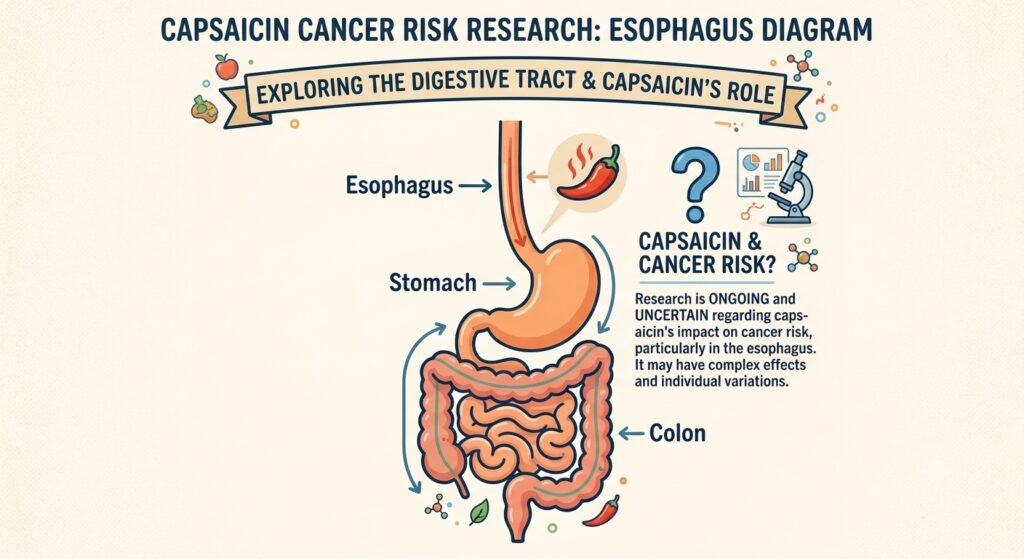
The compound that makes chili peppers spicy is called capsaicin. It’s the same stuff that makes your mouth burn and your eyes water. Capsaicin works by activating a receptor in your body called TRPV1, which is basically your body’s heat-and-pain sensor.
Scientists have a theory (still unproven) that repeatedly exposing the lining of your esophagus to that “burning” sensation, especially with very hot food or drinks over many years, might slowly irritate the tissue. Over time, that repeated irritation could theoretically make cells more prone to mutating or becoming cancerous.
But — and this is a big but — capsaicin isn’t just a villain. Lab studies have also shown it can have anti-inflammatory effects and can even trigger cancer cell death in some experiments. Some large studies have actually linked frequent spicy food consumption to lower rates of certain diseases, including a Chinese cohort study that found people who ate spicy food 6–7 days a week had a lower risk of esophageal cancer than people who never ate spicy food, especially among non-smokers and non-drinkers.
So capsaicin’s relationship with cancer risk isn’t a simple “good” or “bad” — it seems to depend heavily on dose, frequency, and what else is going on in a person’s diet and lifestyle.
What Do Actual Doctors Say About This?
Newsweek reached out to a medical expert, Dr. Edmundo Rodriguez-Frias, a medical contributor at a recovery center in New Jersey, who said that right now, the evidence isn’t strong enough to tell healthy people to stop eating spicy food. Basically: don’t panic and throw out your sriracha just yet.
Researchers involved in the review themselves said something similar — they emphasized that the biggest unanswered question is dose. Nobody has clearly figured out where the line is between “this amount of chili pepper is totally fine” and “this amount might start adding risk.” The people showing the highest risk in these studies tend to be extremely heavy, frequent consumers — not people who casually add hot sauce to their eggs a few times a week.
So… Should You Be Worried?
Honestly? Probably not, unless you’re eating chili peppers in extreme quantities on a near-daily basis for years and years, on top of other risk factors like smoking or heavy drinking. For the average spicy food lover, current research does not support cutting chili peppers out of your diet.
That said, if any of the following apply to you, it might be worth a conversation with a doctor:
- You have a family history of esophageal or GI cancers
- You regularly eat extremely spicy food alongside very hot drinks
- You smoke or drink alcohol heavily in addition to eating a lot of spicy food
- You’ve noticed symptoms like persistent trouble swallowing, unexplained weight loss, or chronic heartburn
For everyone else, moderate spice lovers can probably breathe easy (and maybe grab a glass of milk after that extra-hot wing challenge, just in case).
The Bottom Line
This study doesn’t prove chili peppers cause esophageal cancer. It shows an association — a pattern worth studying further, especially in populations that eat huge amounts of chili peppers regularly. Scientists are still trying to figure out whether it’s the chili peppers themselves, the way they’re cooked, other lifestyle habits, or some combination of all of it.
Until more solid research comes out — ideally studies that can track cause and effect more directly — the safest takeaway is the boring but accurate one: everything in moderation. Enjoy your spicy food, but maybe don’t make “eating the world’s hottest pepper” a weekly hobby.
Sources
- ScienceDaily — Eating chili peppers may raise the risk of one deadly cancer
- Medical Daily — Heavy Chili Pepper Consumption Linked to Substantially Higher Esophageal Cancer Risk, Review Finds
- Medical Dialogues — Study Links High Chili Pepper Consumption to Increased Esophageal Cancer Risk
- PMC / Frontiers in Nutrition (original meta-analysis) — Association between chili pepper consumption and risk of gastrointestinal-tract cancers: A meta-analysis
- ScienceDirect — High spicy food intake may increase the risk of esophageal cancer: A meta-analysis and systematic review
- Newsweek — Common Cooking Ingredient Could Raise the Risk of One Deadly Cancer
- OncoDaily — Spicy Food and GI Cancer Risk: Myths, Facts, and Evidence From Large Cohort Studies (2019–2025)
- SciTechDaily — New Research Finds Shocking Link Between Chili Peppers and Cancer
- SoylentNews (community discussion) — Eating Chili Peppers May Raise the Risk of One Deadly Cancer
- Knowridge — Scientists explore whether heavy chili pepper consumption could affect cancer risk
Disclaimer: This content is for informational purposes only and is not intended as medical advice, diagnosis, or treatment. Always seek the advice of a qualified healthcare provider with any questions you may have regarding a medical condition.